90 Day Engineering Plan to Lock AI Content NDA for Solo Founders

An AI content NDA isn’t a legal document you sign. It’s a set of technical and operational boundary controls, training opt-outs, attribute-based access control, redaction before ingestion, and tamper-evident audit logs, that keep your prompts, drafts, and product details out of someone else’s model. Get this right and your proprietary content never touches a training pipeline, every access is logged, and sensitive spans get scrubbed before anything leaves your network. Enterprise or API-tier contracts with dataset-exclusion clauses are usually what makes this defensible as “reasonable measures” under trade-secret law.
TL;DR:
- Using enterprise or API-tier AI accounts with dataset-exclusion clauses is essential to meet the “reasonable measures” standard under trade-secret law.
- Implementing attribute-based access control, redaction, and tamper-evident logs ensures prompts and drafts remain confidential and auditable.
- Building daily operational controls, like sanitizing prompts and versioning prompt libraries, reduces the risk of accidental data leaks.
- Proper controls can be set up in as little as a weekend, focusing first on auditing accounts and disabling default training settings.
- Content safeguards are most effective when integrated into workflows and enforced by platform features, not just through legal agreements.
Table of Contents
- What Are the Core Technical Controls for an AI Content NDA?
- What Should Your Team Do Every Day to Protect AI Content?
- How Do You Roll This Out in 90 Days?
- How Crontent Approaches NDA-Level Boundaries
- The Part Most Founders Get Backwards
- Get NDA-Level Controls Without Building Them Yourself
- Sources
- FAQ
What Are the Core Technical Controls for an AI Content NDA?
Most founders think confidentiality starts with a signature. It actually starts with a settings screen. The single biggest exposure risk is running sensitive prompts through a consumer-tier AI account, where training on user inputs is often the default unless you dig into settings and manually opt out. Enterprise and API tiers typically exclude training by default, which is the difference between “reasonable measures” and a lawsuit waiting to happen under the Defend Trade Secrets Act.
Here’s what actually needs to be in place before a prompt containing product details or unreleased copy goes anywhere near a model:
- Zero data retention or enterprise/API contracts. Anthropic’s ZDR arrangement means prompts and outputs aren’t stored at rest after the response returns, a materially different guarantee than a standard consumer account.
- Attribute-based access control (ABAC). Every agent and every human should hit a policy check at retrieval time, not just at login. Governance layers that enforce ABAC alongside FIPS-validated encryption can produce an audit-ready evidence trail regardless of which model you’re running behind the scenes.
- Redaction and tokenization. Strip or replace sensitive spans, customer names, unreleased feature names, pricing tiers, before the text ever leaves your infrastructure.
- Tamper-evident audit logs. Record agent identity, model version, a hashed fingerprint of the prompt, and a timestamp. Append-only storage means nobody can quietly edit the trail after the fact.
- Key management. Bring-your-own-key (BYOK) gives you revocation power; vendor-managed KMS is simpler but ties your security posture to someone else’s incident response.
One insight founders miss: prompts are IP artifacts, not throwaway chat text. Treating them with semantic versioning, immutable releases, changelogs, the works, means you can prove what generated a given piece of content and when it changed.
Pro Tip: Never ask a model to “write like [competitor]” or mimic a proprietary internal style guide verbatim. You’re teaching it your methodology, and that’s exactly the kind of leak an NDA-level policy is supposed to prevent.
What Should Your Team Do Every Day to Protect AI Content?
Controls only work if someone follows them at 4 PM on a Friday when a draft is due. Build the checklist into the workflow, not into a wiki page nobody opens.
- Assign seats by sensitivity. Reserve enterprise or API-tier accounts for anything touching unreleased product details; consumer tiers are fine for brainstorming public-facing topics.
- Sanitize before you paste. Swap real customer names, pricing, and roadmap items for placeholders before content goes into any prompt window.
- Use private preview environments. Drafts in progress belong in workspaces with controlled access, not shared docs anyone on the team can screenshot.
- Maintain role-based prompt libraries. Version them semantically (v1.2, v1.3) so changes are traceable and access can be scoped by role.
- Log and set retention windows. Know how long prompts persist and have a deletion workflow ready when a client or team member requests it.
- Have an incident response step ready. If sensitive information slips into an unapproved tool, you need a documented process: revoke access, request deletion, and notify anyone affected within a set window.
The Product Marketing Alliance checklist makes a point worth repeating: combining legal clause language with actual architecture is what makes protection stick. A dataset-exclusion clause means nothing if your team is still pasting drafts into a free consumer chatbot.
Pro Tip: Keep a single “approved tools” doc pinned somewhere your whole team actually sees it. If a tool isn’t on the list, nothing sensitive goes into it, full stop.
How Do You Roll This Out in 90 Days?
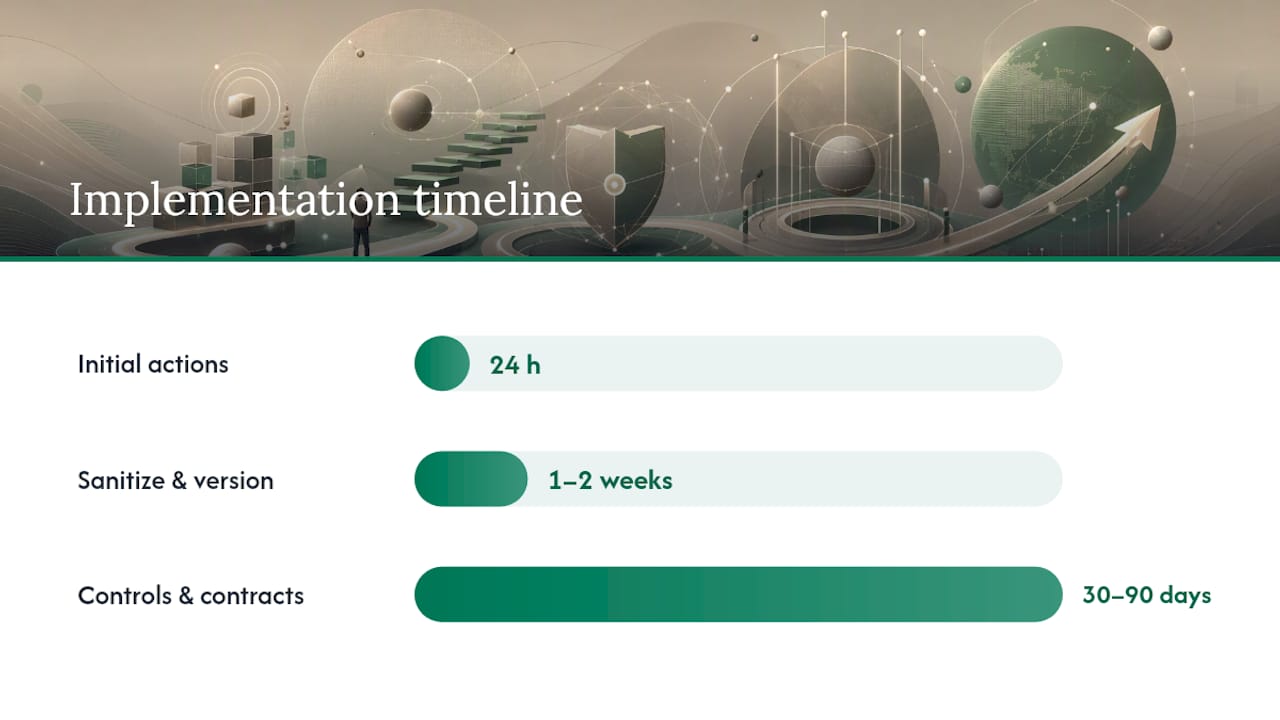
You don’t need a security team to implement NDA-level controls. You need a weekend, then a couple of follow-up sprints.
Within 24 hours:
- Audit every AI account your team uses, including personal logins people signed up for on their own.
- Disable “improve the model” or training-data settings anywhere they’re on by default.
- Move any work touching unreleased features or proprietary prompts to an approved enterprise or API/ZDR account.
Within 1 to 2 weeks:
- Build sanitized prompt templates that force placeholders for customer names, pricing, and roadmap details.
- Implement basic client-side redaction or hashing scripts that strip sensitive fields before any network call goes out, no vendor changes required.
- Start versioning your prompt library instead of treating prompts as disposable chat history.
Within 30 to 90 days:
- Implement ABAC at the retrieval layer so every agent query checks permissions automatically.
- Route logs to append-only storage or a SIEM system so nothing can be edited after the fact.
- Negotiate a signed DPA or dataset-exclusion clause with any vendor handling sensitive workflows, especially where content touches customer data.
Verification checkpoint: assemble an evidence package before you need one. That means exported logs, signed contracts, and screenshots of retention settings, everything an auditor or acquirer’s legal team would ask for if they questioned whether you took “reasonable measures” to protect trade secrets. Teams that scale their AI content workflows safely tend to build this evidence trail from day one rather than reconstructing it under pressure.
How Crontent Approaches NDA-Level Boundaries
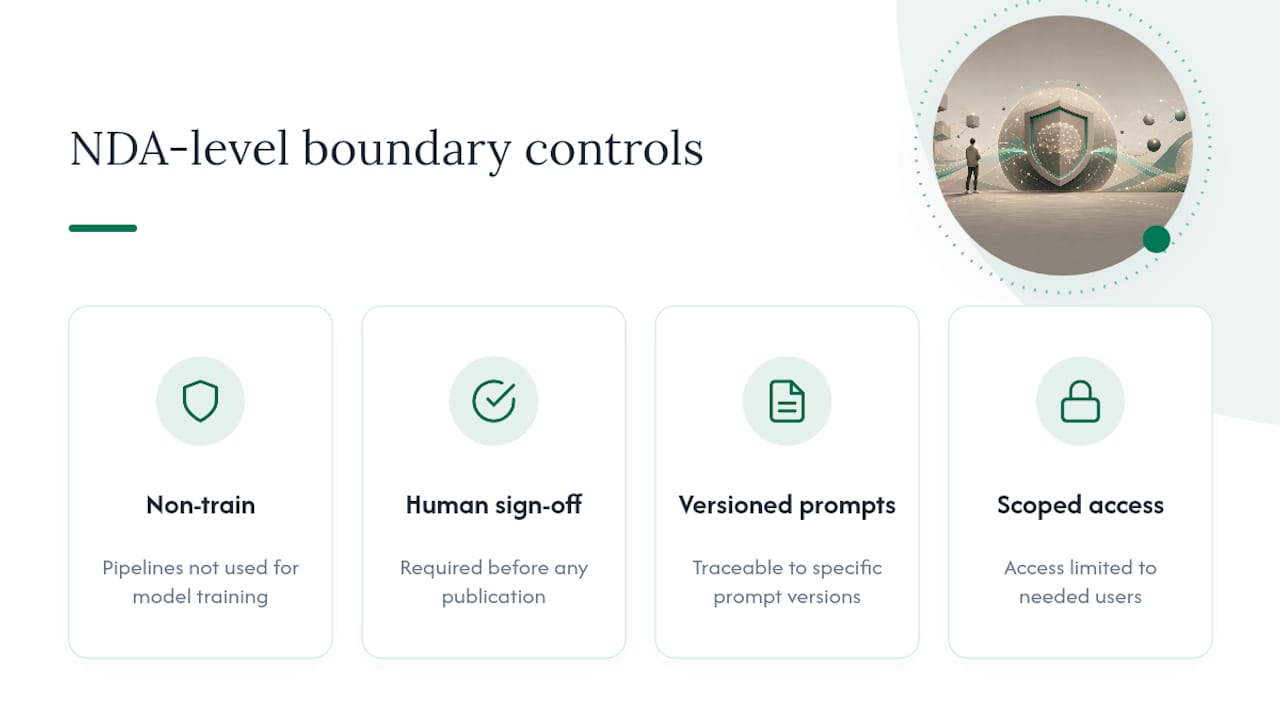
Content automation only earns trust when the defaults are conservative. Crontent runs on non-training pipelines by design, meaning your prompts and product details aren’t recycled into someone else’s model, and every sensitive draft requires human sign-off before it ever gets published. There’s no auto-publish switch to accidentally leave on.
Prompt libraries inside Crontent’s workflows are versioned the same way you’d version code, not treated as disposable chat history. That matters when you need to show exactly what generated a piece of content and trace it back if a client or investor asks. Admin controls are enforced, not optional, which keeps access scoped to the people who actually need it. It’s a smaller-scale version of the same governance-layer thinking that larger platforms document publicly: policy enforced at the point of access, not bolted on after a mistake.
The Part Most Founders Get Backwards
Most advice on this topic treats NDA-level protection as a legal problem you solve by adding a clause to a contract. That’s backwards. A signed agreement with a vendor means nothing if your team is still pasting unreleased feature names into a free chatbot on a Tuesday afternoon. The DTSA’s “reasonable measures” standard cares about what you actually did, not what you promised in writing.
If you’re a solo founder with no legal budget, prioritize in this order: kill consumer-tier training defaults first, add basic redaction second, worry about formal DPAs third. The first two cost you an afternoon. The third takes a negotiation you can have once you’ve already proven you’re serious about data handling. Skipping straight to contract language while your team still runs sensitive prompts through free tools is theater, not protection.
— Jose
Get NDA-Level Controls Without Building Them Yourself
Crontent maps directly onto the controls this article just walked through: non-training pipelines, versioned prompt libraries, and mandatory human review before anything sensitive gets published. You’re not stitching together a governance layer, a redaction script, and a logging system on your own time. It’s built into how the platform drafts your blog posts, LinkedIn content, and video scripts from day one.

If you’re a solo founder or small SaaS team tired of choosing between “publish consistently” and “keep our roadmap private,” that tradeoff shouldn’t exist. Check out the Starter or Pro plans and start a trial run to see how your first batch of research-backed content comes out, and what the security checklist looks like in practice, before committing to anything.
Sources
- The Creator’s Guide to Generative AI: How to Prompt Without Giving Away Your IP — DP&F
- Anthropic platform docs: API and data retention
- Kiteworks Compliant AI: Secure Data Governance for AI Agents
- AI security and privacy checklist for product marketers — Product Marketing Alliance
FAQ
What Is an AI Content NDA?
It’s the combination of technical settings and operational policies, training opt-outs, access controls, redaction, and audit logs, that keep prompts and drafts confidential inside a content automation workflow. It’s not a signed legal template; it’s the infrastructure that makes a confidentiality promise enforceable.
How Is This Different From a Traditional NDA?
A traditional NDA is a legal promise between parties. NDA-level content controls are the technical proof that the promise is being kept, things like dataset-exclusion clauses and access logs that show exactly who touched what and when.
Does Crontent Support NDA-Level Content Protections?
Yes. Crontent runs on non-training pipelines, versions prompt libraries as IP artifacts, and requires human review before any sensitive draft publishes. Pricing for the Starter and Pro plans is available directly on the Crontent site.
Can a Consumer-Tier AI Account Ever Meet NDA Standards?
Generally no, since consumer tiers often default to training on user inputs unless manually opted out, which undermines the “reasonable measures” standard under trade-secret law. Enterprise or API accounts with contractual exclusions are the safer baseline for anything touching product details.
What’s the First Thing a Solo Founder Should Fix?
Audit every AI account your team uses and disable any “improve the model” or training-data setting still on by default. That single step closes the biggest exposure gap before you spend any time on contracts or redaction tooling.