Run 3 Blog Case Study Experiments for Marketers in 60 Days

Look for blog-format case studies on specialist vendor blogs, university case repositories, government collections, and focused growth blogs, and prioritize pieces that publish clear methodology and before/after metrics. Before trusting a claim, check three things: a measurable outcome, an explained method, and a link back to primary data. The rest of this guide shows you exactly where to look, how to judge quality fast, and how to turn three real examples into experiments you can run yourself.
TL;DR:
- High-quality case studies should include a clear goal, baseline metrics, and an explanation of measurement methods to verify the accuracy of results.
- Reliable sources include vendor blogs, academic repositories, government collections, and top-tier business media like Harvard Business Review, each with distinct strengths.
- Evaluate case studies quickly by checking for documented methodologies, verified data links, author credentials, and consistent publication dates to identify trustworthy claims.
- When replicating case studies, focus on one experiment at a time, use relevant metrics, and ensure resources match the scope of the test to produce meaningful results.
- Respect copyright and data ethics by citing sources, attributing numbers, and building your own dataset rather than copying entire case studies without permission.
Table of Contents
- Where to Find High-Quality Case Studies From Blogs
- How Do You Evaluate a Blog Case Study Quickly?
- Three Blog Case Studies Worth Dissecting
- How to Turn Case-Study Lessons Into Your Own Content
- Can You Legally Reuse a Blog Case Study?
- A Working Perspective on Blog Case Studies
- A Faster Way to Draft Your Next Case Study Post
- Sources
- FAQ
Where to Find High-Quality Case Studies From Blogs
Most marketers start with a Google search and stop at the first vendor blog that shows up. That works, but it’s the shallow end of the pool. Four channels consistently produce better material, each with a different bias worth knowing before you read.
Vendor and product blogs publish some of the most detailed operational case studies you’ll find, because the company has full access to its own analytics. ThingLink, the interactive-image platform, runs a blog of customer case studies covering education and training use cases with concrete engagement numbers. The catch: vendor blogs select their best customers and rarely publish a failed rollout, so read them for tactics, not for base rates.
University and teaching case repositories trade marketing polish for methodological rigor. Cranfield University’s library recommends searching EBSCO Business Source Complete and ProQuest One Business and filtering the Document/Publication Type field to “Case Study,” which surfaces peer-reviewed, teaching-grade material instead of blog posts dressed up as research. MIT Sloan’s teaching resources library organizes cases the same way business schools use them in class, with the method spelled out step by step.
Government innovation collections are underused by content marketers. The Gov publishes public-sector projects with primary data attached, since taxpayer-funded programs face disclosure requirements that private vendors don’t.
The Case Centre and Harvard Business Review sit at the top of the pyramid for structured, teachable material. The Case Centre’s student resources and the HBR case studies store both package cases with teaching notes explaining exactly what analytical lens to apply, which is rare outside academia.
Beyond these, independent niche blogs and agency case studies often contain the freshest, most specific tactics; explore detailed examples and outcomes in Our Services — Social, SEO, Websites & Automations | HarbourSide Digital. Use search operators to dig them up:
site:domain.com "case study" + [your keyword]to find a specific company’s published examples"case study" "increased traffic" [industry]for growth-marketing examples with outcome language baked into the query- Database filters set to “Case Study” in EBSCO or ProQuest for anything academic
Pro Tip: Search for the same case study title in quotes on a different date range in Google. If nobody else has cited or discussed the numbers, treat the claim as unverified rather than false.
How Do You Evaluate a Blog Case Study Quickly?
Not every case study labeled “case study” deserves the name. A lot of them are testimonials with a chart pasted on top. Here’s a fast checklist to run before you trust or reuse anything:
- Goal clarity. Does the post state what it was trying to achieve before showing results, or does it work backward from a good number?
- Baseline metrics. Is there a “before” figure, or does the post only show the “after”?
- Timeframe and sample size. A 466% jump over six years reads very differently than the same jump over six weeks.
- Measurement method. Does the author explain how the number was tracked, single-touch, multi-touch, or self-reported?
- External links. Does the piece link to dashboards, raw data, or a corroborating source, or does it just assert?
Trust signals stack in a predictable order. A named byline with real credentials outranks “Team” as an author tag. A published date and a visible “updated” timestamp outrank a static post with no date at all, since stale numbers get quietly recycled for years. A dedicated “how we measured this” section, even three sentences long, outranks a chart with no explanation underneath it.
A useful data point: Mint Studios’ fintech case study reports SQLs from the blog grew by 466%, but the post earns credibility by explaining it used multi-touch tracking rather than crediting the blog for every lead that happened to read a post once. That single methodological disclosure is what separates a defensible claim from a vanity number.
Red flags include screenshots with cropped-out date ranges, percentage gains with no starting number, and “case studies” that never name the company. When in doubt, run the URL through the Wayback Machine to see if the numbers changed between versions, or search for the company name plus the metric to see if any other source corroborates it.
Three Blog Case Studies Worth Dissecting
Reading a case study passively teaches you nothing. Pulling one experiment out of it does. Here are three, each aimed at a different kind of marketer.
Example A: the vendor blog case. ThingLink’s customer case studies typically follow a context, problem, solution, outcome structure aimed at education and corporate training buyers. The replicable tactic isn’t the platform, it’s the structure: state the specific problem a customer had before showing the tool as the fix, rather than opening with features. Adapt this by rewriting your own next case study to open with the customer’s actual complaint in their words.
Example B: the government or university case. The gov.uk innovation collection and academic cases indexed through Cranfield’s library earn credibility because the method section is often longer than the results section. Marketers can adapt this by publishing a short methodology paragraph in their own case studies, even a few sentences on how a metric was pulled, since that alone puts you ahead of most vendor content.
Example C: the independent blog growth case. The 2026 DevelopersDigest case study documents a workflow that shipped 155+ features and 15+ blog posts using parallel AI agents and structured processes, and its value comes from transparency about the process, not just the output count. Separately, InspireToThrive’s blog growth case study found that updating existing posts and adding visible author signals drove more of the traffic gain than new publishing alone.
| Example | Baseline | Result | |
|—|—|—|—| | ThingLink-style vendor case | No documented use case for a specific customer segment | Named customer outcome with engagement metric | Rewrite one case study opening around the customer’s original complaint | | Government/university case | Undocumented internal process | Published methodology with primary data | Add a two-sentence “how we measured this” section to your next post | | Independent blog growth case | Existing back catalog of posts | Traffic gains tied to updates and author signals | Refresh your three oldest high-traffic posts and add a named byline |
Pro Tip: Pick one row, not all three. Running three experiments at once makes it impossible to tell which one actually moved the number.
How to Turn Case-Study Lessons Into Your Own Content
A case study is only useful once it becomes a test you can run. Here’s a simple workflow for converting what you read into something that produces its own data.
- Write a one-line hypothesis. Example: “Adding a named author bio to our top five posts will increase average time on page within 60 days.”
- Pick one metric and one timeframe. Don’t measure five things at once; pick the metric the source case study actually used, so your results are comparable.
- List the resources you actually have. A solo founder testing a headline change needs an afternoon. Testing a full repurposing funnel needs a content calendar and a few weeks.
- Repurpose the win, don’t just report it. Turn the blog post into a short-form social snippet, then a two-email sequence, then a one-page sales enablement asset if the topic supports a buying decision.
- Track with more than one touchpoint. Single-touch attribution tells you a visitor arrived; multi-touch tracking tells you whether that visitor became a qualified lead months later, which is the harder and more honest number to report.
Realistic timelines matter here. Blog-driven pipeline effects tend to show up over months, not days, so set your measurement window before you start, not after you see a number you like.
If you’re using AI to accelerate the research and drafting stage, keep a human in the editorial loop before anything publishes. Crontent’s own editorial guidelines for AI walk through how small teams can set that governance up without slowing themselves down, and the guide on structuring content for AI citation is worth a look if your goal is getting your own case study cited elsewhere.
Can You Legally Reuse a Blog Case Study?
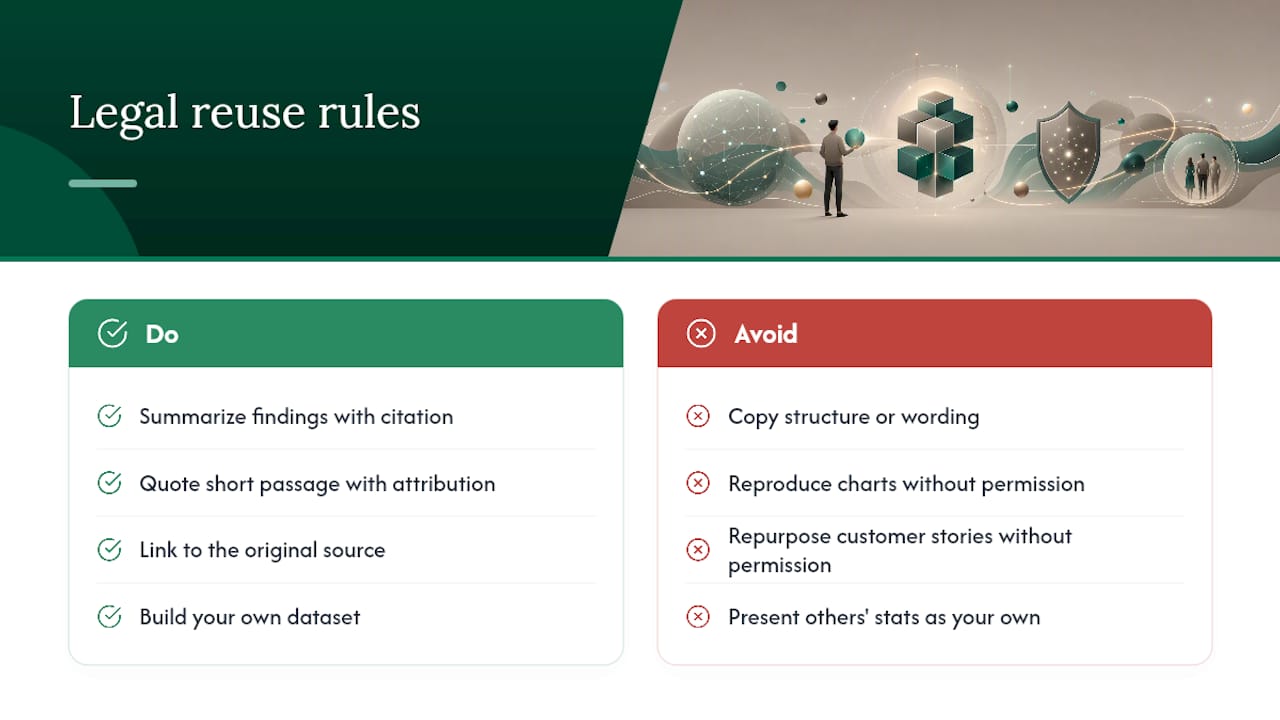
Reading a competitor’s or a vendor’s case study and applying the lesson is fine. Copying its structure, wording, or data without attribution is not, and the line between the two trips up more marketers than you’d expect.
Case studies are copyrighted the moment they’re published, the same as any blog post. You can summarize a finding, quote a short passage with attribution, and link to the source, but lifting whole paragraphs or reproducing a chart without permission is a copyright issue, not a gray area. If a case study includes a customer’s name, logo, or direct quote, that customer typically consented to that specific use only, meaning you can’t repurpose their story as if it were your own client’s without separate permission.
Data ethics matter just as much as copyright. If you’re citing a statistic from someone else’s case study in your own content, link to the original rather than restating it as if you generated it yourself; readers and search engines both increasingly check for that kind of primary-source trail. And if you’re adapting a methodology, like a “how we measured this” format, that’s a technique, not a protected asset, so build your own version rather than copying phrasing verbatim.
The safest practice: treat every blog case study you read as a source to cite, not a template to trace over. Attribute the numbers, credit the author, and build your own dataset from your own results.
A Working Perspective on Blog Case Studies
Blog case studies matter precisely because they’re dated and specific, unlike a “best practices” listicle that never expires. My advice for small teams: pick one experiment from one case study, not three from three. Match the test to the resources you actually have this month. Use AI to speed up the research and first draft, but keep a human reviewing the claims before anything ships.
— Jose
A Faster Way to Draft Your Next Case Study Post
If you’ve read this far, you already know the hard part isn’t finding case studies, it’s finding the time to write your own. Crontent builds research-backed drafts for solo founders and small SaaS teams, pulling from current sources and your own stated opinions instead of generating generic filler.

A first project typically starts with your product’s actual angle, not a template: Crontent reads relevant sources, drafts a case-study-style post with citations attached, and hands it back for your review before anything publishes, since nothing goes live without a human check. That first research-backed draft is usually the fastest way to see whether the workflow fits how your team already writes. If you want your own experiments, like the ones in the table above, turned into a published post without blocking out a full afternoon, check the Starter and Pro plans and start your first content run.
Sources
- Looking for case studies? - Cranfield University Blogs
- MIT Sloan teaching resources library: case studies
- Gov
- HBR store: case studies
FAQ
Are Blogs Still Relevant in 2026?
Yes. Blogs remain a primary way companies publish primary-source data, methodology, and dated case studies that AI tools and search engines both rely on for grounded answers. The DevelopersDigest case study shows a single blog project producing 155+ features and 15+ posts in one workflow, evidence that blogs are still where teams document real, checkable outcomes.
Can ChatGPT Create a Case Study?
AI can draft the structure and first pass of a case study fast, but it can’t originate real data, customer quotes, or measured outcomes on its own. The reliable approach is using AI to accelerate research and drafting while a human supplies the actual results and reviews every claim before publishing, which is the model Crontent’s editorial governance guide is built around.
What Are the Top Blogs for Case Studies?
There’s no single official “top ten” list, but the most reliable sources by category are vendor blogs like ThingLink for product use cases, academic repositories like MIT Sloan and Cranfield for methodology, gov.uk for public-sector transparency, and HBR or The Case Centre for teaching-grade structure. Independent growth blogs like InspireToThrive and Mint Studios add real commercial numbers with attribution methods explained.
How Do I Know if a Blog Case Study’s Numbers Are Trustworthy?
Check for a stated baseline, a defined timeframe, and an explanation of how the metric was measured, single-touch or multi-touch. If a post shows a percentage gain with no starting number or measurement method, treat the number as marketing copy rather than a data point.