Link Earning With Research for Small SaaS: Earn Links in 30–90 Days

Original, well-packaged research published as a web-native blog post is the fastest way small SaaS teams can earn authoritative backlinks and AI citations. A narrow, high-information-gain question tied to your actual audience beats a broad survey nobody asked for. Publish it with bite-sized stats, embeddable charts, and clear methodology, and the links tend to follow.
TL;DR:
- Publishing original research with clear methodology and bite-sized stats can generate backlinks and media citations that last for over a year.
- Selecting niche, specific questions that answer outdated or unverified data increases your chances of earning authoritative links and citations.
- Using small-scale methods like product telemetry, focused surveys, or public data analysis, with transparent methodology, produces credible, citation-worthy results.
- Packaging research findings with embeddable visuals, a prominent stats list, and accessible data makes it easier for writers and AI models to reuse your content.
- Launching with a coordinated outreach plan, including embargoed journalist lists and community amplification, maximizes early link velocity and long-term impact.
Table of Contents
- Why Original Research Earns Links and AI Citations
- How Do You Pick a Research Question Worth Publishing?
- What Methodology Actually Holds Up on a Small Budget?
- How Do You Package Findings So Writers Can Reuse Them?
- How Should You Sequence Launch and Outreach?
- What Should You Track, and How Fast Will It Pay Off?
- What Legal and Ethical Lines Matter Here?
- Which Small Studies Actually Earned Real Links?
- Which Content Formats Get the Most Out of One Research Project?
- Why Research Has to Be a Habit, Not a Project
- How Crontent Fits Into a Research-Driven Content Cadence
- Sources
- FAQ
Why Original Research Earns Links and AI Citations
Journalists and bloggers need something to point to. A stat with no source behind it is an opinion; a stat tied to a dated, named study is evidence a writer can cite without checking further. That’s the entire mechanism behind link earning with research: you become the primary source, and everyone writing about your topic afterward needs somewhere to point.
The same logic applies to AI models. Answer-first structure and named, dated sources make content easier for large language models to extract and cite, which matters more every quarter as AI answers absorb search traffic that used to land on blog posts directly.
What makes this worth the effort is the compounding curve. A single well-produced research report can generate more backlinks and media citations than dozens of standard blog posts, and it keeps earning links for a year or more after publication, long after a typical listicle stops getting new traffic.
A few reasons this outperforms regular content marketing:
- Data is quotable in ways opinion pieces rarely are.
- One study can serve as a source for dozens of unrelated articles across different niches.
- It builds domain authority that lifts every other page on your site, not just the study itself.
Statistic to remember: A single strong research asset can keep generating backlinks and media citations for 12 months or longer after launch, according to industry analysis of B2B research campaigns.
How Do You Pick a Research Question Worth Publishing?
Most founders pick a topic that’s interesting to them, not one that passes the information-gain test. Ask instead: does this study produce data nobody else has, or does it directly contradict a number people keep citing that’s actually stale? Both give writers a reason to link to you specifically instead of a competitor covering the same ground.
- Narrow the audience first. “How SaaS founders price annual plans” beats “pricing trends in tech.” A tightly scoped question is easier for a journalist to cite because it’s specific enough to sound authoritative.
- Check Google Trends and social listening for questions your audience keeps asking without a clear, sourced answer. Recurring, unanswered questions in niche Slack groups or subreddits are gold.
- Build a citation-replacement list before you even collect data. Search for articles quoting outdated statistics in your space, note who wrote them, and design your study to produce the number that replaces theirs.
- Pressure-test the angle with one sentence. If you can’t summarize the finding as a single punchy stat, the question is still too broad.
Pro Tip: Search “[your industry] statistics” plus the current year and look at what ranks. If every result cites a study from three or more years ago, you’ve already found your replacement-citation angle before collecting a single data point.
What Methodology Actually Holds Up on a Small Budget?
You don’t need a market-research firm to publish something journalists will trust. Three methods work at founder scale, each with a different credibility trade-off.
- Anonymized product telemetry. Usage data from your own product is often the strongest option for a small team, because it’s real behavior rather than self-reported opinion. Even a modest sample is defensible if you’re transparent about scope and limitations.
- Tight surveys. Eight to fifteen closed questions plus a couple of open-ended prompts tend to produce more usable, quotable results than a long, unfocused questionnaire that fatigues respondents.
- Public-data analysis. Pulling structured conclusions from data that’s already public (job boards, pricing pages, app store listings) costs nothing to “recruit” but requires airtight methodology notes to avoid looking like a scrape-and-guess job.
Whichever method you pick, publish the details plainly: sample size, how participants were recruited, the exact dates data was collected, and what you excluded and why. Vague methodology is one of the fastest ways a journalist disqualifies a study before they’ve even read your findings.
Pro Tip: State your sample size in the first paragraph of your methodology section, not buried in an appendix. Writers scan for it, and its absence reads as something you’re hiding.
How Do You Package Findings So Writers Can Reuse Them?
A gated PDF kills your own link earning before it starts. Editors and bloggers won’t fill out a form to quote your stat, and search engines can’t crawl what’s locked behind a gate. Backlinko’s original-research guidance is blunt about this: publish results as a normal, web-native blog post, report your numbers in bite-sized stats, and give writers embeddable visuals they can drop straight into their own posts.
Structurally, your write-up needs:
- A headline stat list near the top, formatted for easy skimming and quoting.
- Charts with embed code, so a writer can paste your visual instead of building their own.
- A downloadable CSV or JSON of the raw data for the more rigorous outlets.
- A short, plainly written methodology summary linked from the top of the page.
| Element | Why it matters |
|---|---|
| eight to fifteen bite-sized stats | Reduces friction; writers copy a sentence instead of paraphrasing a paragraph |
| Embeddable chart code | Increases the odds of image credit and a backlink together |
| Central stats hub page | Gives journalists one URL to bookmark and reference repeatedly |
| Public methodology summary | Prevents fast disqualification by skeptical editors |
Maintaining an always-updated stats hub rather than a one-time post also means old links keep pointing to something current, instead of decaying alongside the data.
How Should You Sequence Launch and Outreach?
Link velocity is front-loaded. Most of what you’ll earn happens in the first 30 to 90 days, so treat the launch like a coordinated push rather than a single press release blasted into the void.
- Build an embargo list five to seven days before launch. Thirty to sixty relevant journalists and bloggers, each pitched individually with the headline finding and an offer of early access.
- Run citation-replacement outreach in parallel. Find writers already citing outdated numbers in your space and pitch your study as the update, not as new content. This consistently outperforms generic blast pitching because you’re solving a problem the writer already has.
- Amplify through community channels on launch day. LinkedIn threads from your own founder account, niche newsletters willing to run a guest mention, and relevant subreddit or forum communities where data-driven posts tend to get traction.
- Follow up once, five to seven days after the first pitch, with a new angle or a fresh stat pulled from the same dataset, then stop chasing that particular contact.
Pro Tip: Keep your embargo pitch under 150 words with the single strongest stat in the first sentence. Journalists decide in seconds whether to open your attachment.
What Should You Track, and How Fast Will It Pay Off?
The first month tells you if the launch worked. The following year tells you if the asset compounds.
| Timeframe | What to track | What it tells you |
|---|---|---|
| 30 days | Social shares, initial press mentions, first backlinks | Whether the outreach and angle landed |
| 30 to 90 days | Referring domains, branded search upticks | Whether the study is spreading organically |
| 90 to 12 months or longer | AI citation checks, sustained referring-domain growth | Whether the asset has become a lasting reference point |
A structured three-track sequence drives most of that early velocity, but the long tail depends on maintenance. Refresh the hub page quarterly with new data points, and re-pitch writers with a new angle once the initial coverage window closes around month three. Checking whether AI tools cite your study when answering related questions is worth adding to that quarterly review, since AI citation behaves differently from traditional backlink accrual and can lag behind press coverage by weeks.
What Legal and Ethical Lines Matter Here?
Publishing research means publishing claims other people will act on, so the bar for honesty is higher than for a typical opinion post. If you’re surveying your own users, disclose that clearly rather than presenting customer opinions as a neutral industry sample. A study of “500 SaaS founders” that’s actually 500 of your own trial sign-ups is misleading by omission, and a sharp journalist will notice and never cite you again.
Consent matters just as much as framing. If you’re analyzing product telemetry, anonymize it thoroughly and check that your own terms of service and privacy policy actually permit that kind of aggregate use. Most platforms allow anonymized, aggregated analysis, but a handful of jurisdictions have specific rules about what counts as anonymized versus merely de-identified, so this is worth a quick check with someone who knows your regulatory environment rather than an assumption.
Never round a number to make a stat punchier. The same goes for cherry-picking a subgroup result and presenting it as if it applied to your full sample. Publish the caveats alongside the stat, not in a footnote nobody reads. Ethical research isn’t just the right call, it’s also the version of the study that survives scrutiny long enough to keep earning links.
Which Small Studies Actually Earned Real Links?
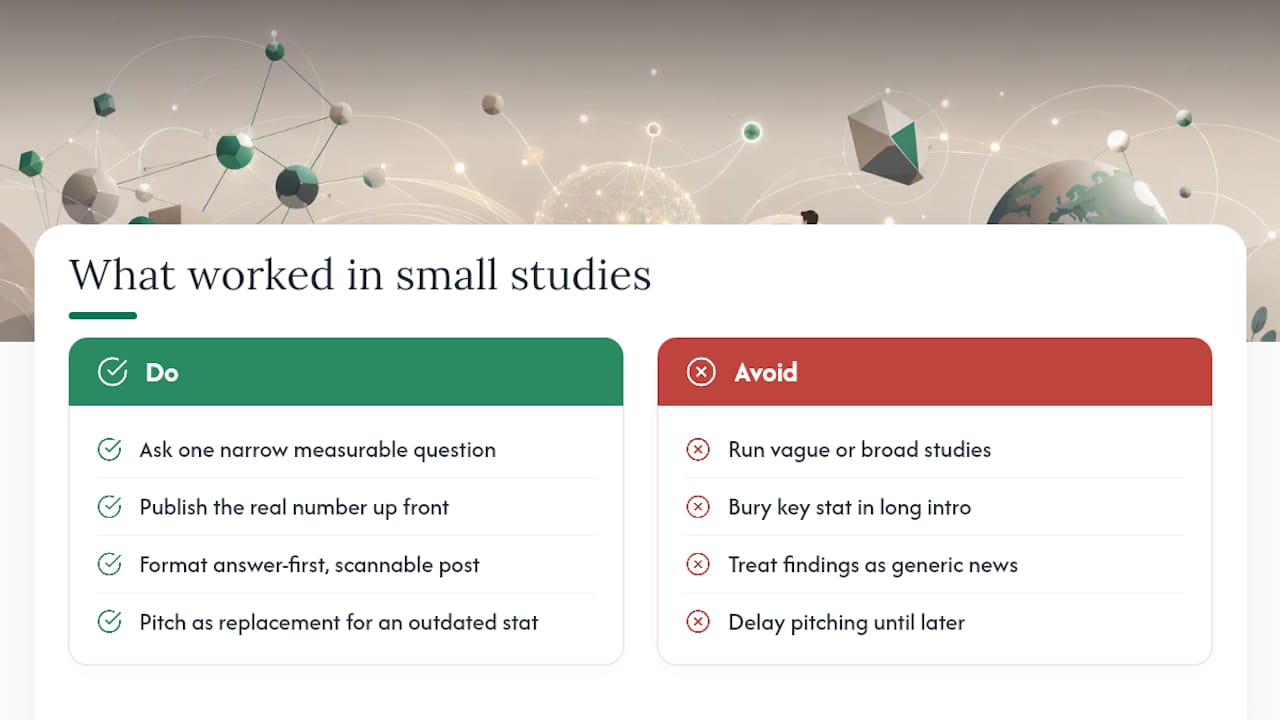
The pattern that works again and again is narrow and specific: a small team answers one question nobody else has bothered to measure, and the resulting number becomes the reference point for that niche. A pricing benchmark pulled from a founder’s own customer base, a churn-rate breakdown by company size, a survey of how long it actually takes support teams to resolve a specific ticket type. None of these require a research department. They require one clear question and a willingness to publish the real number, even when it’s unflattering.
What separates the studies that earned sustained links from the ones that got a single share-and-forget mention is the packaging. The successful ones showed up as a clean, scannable blog post with a stat pulled into the first paragraph, not buried under three sections of introduction. That structural choice does double duty: it satisfies human skimmers and it happens to be exactly what improves pickup by AI answer engines as well, since both audiences reward the same answer-first formatting.
The other consistent thread is timing. Teams that pitched their data as a replacement for a specific outdated stat, rather than as generic news, got picked up faster and by more targeted outlets. That’s the citation-replacement approach in action, and it’s replicable regardless of your niche or team size.
Which Content Formats Get the Most Out of One Research Project?
One dataset can fund several distinct pieces of content, each with a different link profile. Treat the underlying research as raw material, not a single finished product.
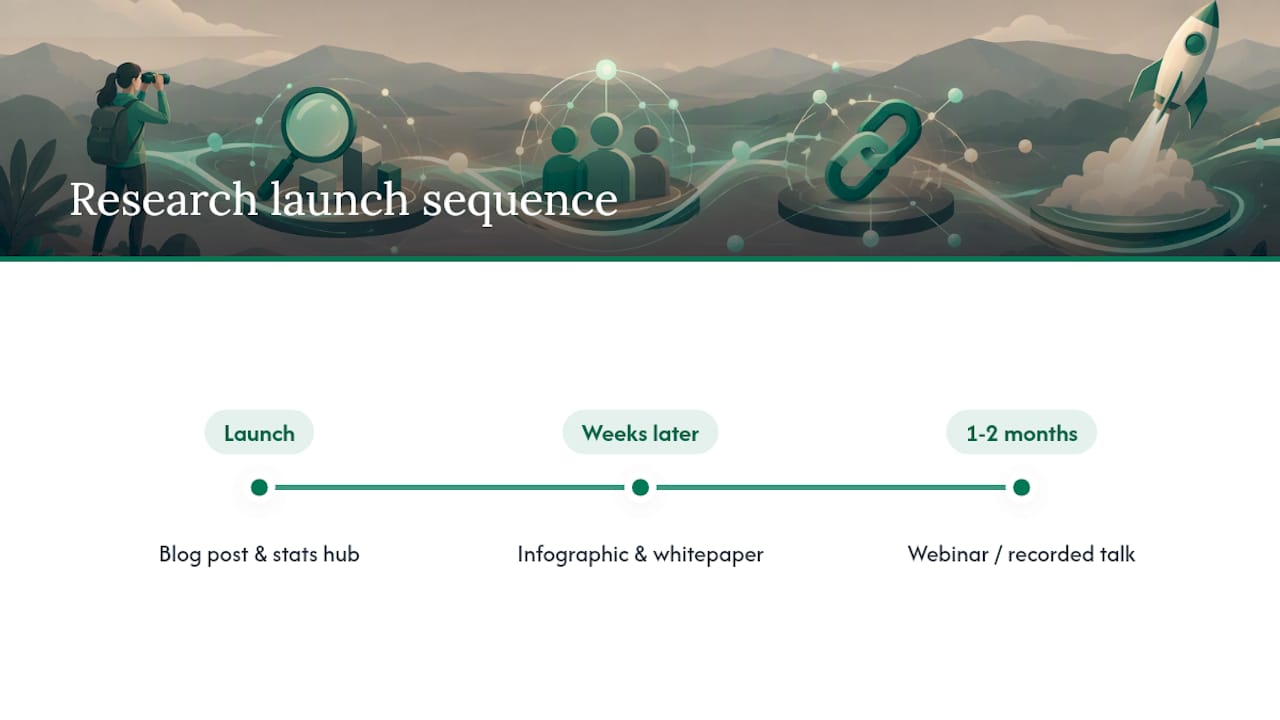
A short whitepaper works for outlets and readers who want the full methodology and every data cut, not just the headline stats, and it tends to attract links from more academic or enterprise-adjacent sites that skip over shorter blog posts. An infographic built from your three or four strongest findings travels well on visual platforms and gets picked up by sites doing roundup-style “state of the industry” posts that need an embeddable image more than a data table.
A webinar or recorded talk walking through the findings gives you a reason to reach out to podcast hosts and newsletter writers who wouldn’t cover a blog post but will happily host a guest talking through original data. It also produces a transcript you can mine for additional bite-sized quotes later. Short video clips pulled from that same webinar work as standalone social content, extending the launch window well past the initial press cycle.
The trick is sequencing, not simultaneous release. Launch the blog post and stats hub first, since that’s what earns the initial backlinks. Roll out the infographic and whitepaper in the following weeks as secondary hooks for the outlets that missed the first wave, then use the webinar a month or two later as your re-pitch angle when the news cycle has moved on.
Why Research Has to Be a Habit, Not a Project
Most founders treat research as a one-time push: ship the study, do the outreach, move on. That’s the wrong model. The teams that get real compounding value treat it as a scheduled, repeatable asset, published on a cadence, with each new wave building on the last dataset instead of starting from zero.
Founder amplification multiplies whatever the study earns on its own. A founder’s personal LinkedIn post about “why we ran this study” routinely reaches people the press outreach never touches, and it’s the cheapest distribution channel you have.
— Jose
How Crontent Fits Into a Research-Driven Content Cadence
Crontent is the practical answer to the gap between “we should publish research” and “we actually did it three quarters in a row.” Running a defensible study, writing it up with proper methodology, and turning it into a blog post plus follow-up social content takes hours most solo founders don’t have twice a year, let alone every month.

Crontent’s agent-based workflow reads your source material, drafts content in your actual voice, and cites every claim back to a real source, so the finished post looks like something you wrote and fact-checked yourself, not a generic AI dump. It supports scheduled publishing across blog posts, LinkedIn, X, and short video scripts, which means one research project can be sequenced into weeks of properly formatted, citation-worthy content instead of a single post that fades in a month. Every draft still goes through you before it publishes, so nothing goes out under your name that you haven’t reviewed.
If you’re ready to turn one good dataset into a repeatable content engine instead of a one-off launch, start with the Crontent Starter or Pro plan and see your first drafts generated from your own source material.
Sources
- Original research (Backlinko guide)
- Original Research for B2B SaaS: The Content Type Your Competitors Can’t Copy
- Original Research as a Link Building Strategy: A Step-by-Step Guide - Link Building Journal
FAQ
How Long Does Link Earning With Research Take to Work?
Most initial backlinks and press coverage land in the first 30 to 90 days after launch if you run a structured outreach sequence. The long tail, including AI citations and passive referring-domain growth, keeps building for a year or more if you maintain and re-promote the hub page.
What Sample Size Do I Need for a Credible Study?
There’s no universal minimum, but transparency matters more than scale. A small, honestly disclosed sample from your own product telemetry can be more defensible than a larger survey with vague recruitment details.
Should I Gate My Research Behind an Email Form?
No. Gated PDFs are harder to crawl, harder to cite, and harder for journalists to quote quickly. Publishing as a web-native blog post with visible stats and embeddable visuals earns more links and citations than a locked-down report.
Does Crontent Help With Research-Driven Content Specifically?
Crontent generates scheduled, source-cited drafts from your research and preserves your brand voice, which fits the packaging and cadence a research-driven content strategy needs. Pricing details for the Starter and Pro plans are available directly on the Crontent site.
What’s the Difference Between Link Building and Link Earning?
Link building usually implies actively requesting or negotiating for links. Link earning with research means publishing something genuinely citable, like original data or a named study, so writers link to you voluntarily because it solves their sourcing problem.