4–8 Posts a Month: SaaS Content Cadence Small Teams Can Sustain

Publish 4 to 8 pieces of cornerstone content a month if you’re a solo founder or a team of two to four, and treat that as a floor, not a ceiling. That range keeps you inside the 11+ posts per month territory once you add repurposed and channel-specific posts on top of your blog output, without burning out the one or two people actually writing. Your move this week: pick one pillar keyword tied to your core product benefit and publish or refresh a single cornerstone page around it. Everything else in your calendar builds off that.
TL;DR:
- Publishing 9 to 11 posts per month consistently boosts organic traffic and long-term lead generation through cumulative search demand.
- Content cadence should be fixed, structured around a clear split between new content and refreshes, with designated owners for each step.
- For new or pre-seed SaaS sites, targeting 6 to 8 posts monthly speeds up search rankings within 60 to 90 days, while established teams aim for 9 to 11.
- Small teams should build content around pillar clusters, creating one cornerstone page with supporting posts that link and reinforce each other.
- Automation tools can help streamline research, drafting, and channel variation, but human review is essential to maintain quality and sourcing credibility.
Table of Contents
- What SaaS Content Cadence Actually Means
- How Often Should SaaS Companies Publish, By Stage?
- What Cadence Should You Use for Each Channel?
- How Do You Build a Cadence You Can Actually Keep?
- How Do You Know If Your Cadence Is Working?
- A Weekly Playbook Small SaaS Teams Can Actually Run
- Three Cadence Mistakes I See Founders Make Over and Over
- Where Crontent Fits Into Your Cadence
- Where to Read More on Publishing Frequency and Timing
- Sources
- FAQ
What SaaS Content Cadence Actually Means
Content cadence isn’t just “how often you post.” It’s the combination of frequency, timing, and format, mapped against where your buyer sits in their decision process. A cadence that ignores that mapping is just noise on a schedule.
Think of it in two layers, an idea SaaStr has popularized under a “two systems” framing for operating a company: one system handles the steady, predictable stuff (weekly blog posts, recurring newsletters), and a second handles the bursty stuff (launches, feature announcements, campaigns). Small teams tend to collapse these into one undifferentiated stream, which is exactly why cadence falls apart the first time a product launch eats a week. Separate them on purpose. Your steady system runs on autopilot with a fixed rhythm. Your burst system gets scheduled around real business events: a new pricing tier, a major release, a funding announcement.
The reason cadence matters at all comes down to compounding. A multi-study analysis tracking blog output over time found that companies publishing 11 or more posts per month saw meaningfully higher organic traffic than companies publishing once a month or less. That’s not a one-time spike. It’s the effect of stacking indexed pages that each capture a sliver of search demand, month after month, until the sum becomes a real traffic channel.
What trips founders up is treating cadence as a sprint instead of a habit. A team that publishes 12 posts in one manic month and then goes dark for two quarters ends up worse off than a team that published 3 posts a month the entire time. Search engines and readers both reward reliability, and gaps read as abandonment.
Here’s what a working cadence actually needs to define, at minimum:
- A fixed frequency per channel (not “whenever we have time”)
- A clear split between new content and refreshed content
- A designated owner for each content type, even if it’s one person wearing three hats
- A launch calendar that your content calendar syncs against, not fights
Get those four things nailed down before you worry about volume. Volume without structure just produces more inconsistency, faster.
How Often Should SaaS Companies Publish, By Stage?
The right frequency depends almost entirely on where your company sits, and pretending otherwise is how founders end up chasing benchmarks meant for a 50-person marketing org.
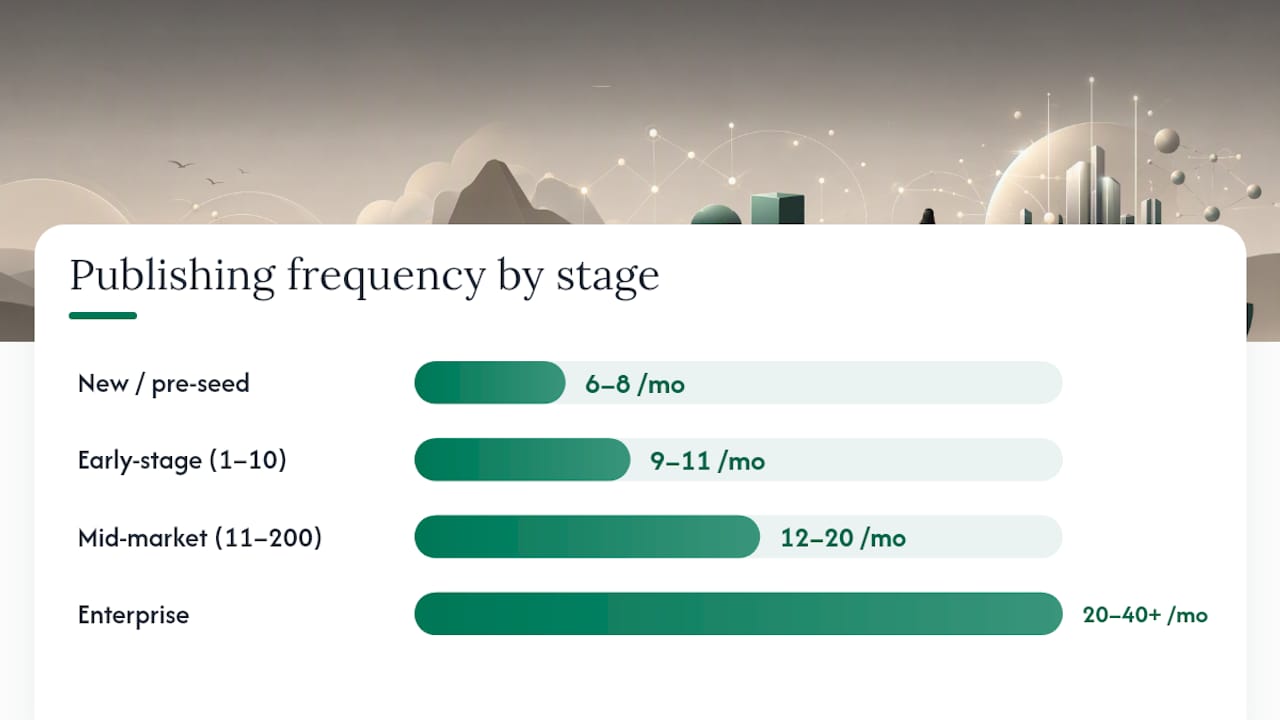
New blogs and pre-seed products need to prioritize velocity over polish for the first few months. Meta-analytic research on blogging frequency found that new sites benefit from 6 to 8 posts a month to build topical authority and start seeing ranking movement within 60 to 90 days. Below that pace, search engines simply don’t have enough signal to understand what your site is about.
Early-stage teams (1 to 10 employees) are where most of this article’s audience lives. Stratabeat’s 2025 report on B2B SaaS publishing found that sites putting out 9 or more posts a month saw a 20.1% increase in monthly organic traffic, with custom graphics and original research driving a meaningfully larger uplift than generic, stock-image posts. That’s the sweet spot for a founder plus a part-time marketer: 9 to 11 pieces a month across blog and repurposed formats, weighted toward quality over raw count.
Mid-market teams (11 to 200 employees) usually have a dedicated content function and can sustain 12 to 20 posts a month once you include supporting content like comparison pages, integration guides, and customer stories.
Enterprise SaaS operates on a different scale entirely, often 20 to 40+ pieces a month across multiple writers, translators, and regional teams. That volume isn’t useful for a two-person startup to benchmark against, and trying to hit enterprise numbers with founder-level bandwidth is a fast way to publish thin content that hurts more than it helps.
Benchmark snapshot: Meta-analysis across multiple studies puts the growth threshold at 11+ posts a month for traffic and lead gains, while Stratabeat’s SaaS-specific data shows 9+ posts a month driving a 20.1% traffic increase. And once a site crosses roughly 400 published posts, the same research points to compounding lead generation that’s about three times higher than sites under 100 posts.
That 400-post milestone matters more than founders realize. It’s not a magic number so much as a proxy for accumulated topical coverage. A site with 400 posts has almost certainly answered hundreds of long-tail questions its competitors haven’t touched, and each of those pages keeps earning traffic long after it was written.
The practical rule for choosing your number: pick the highest cadence you can sustain without dropping quality below the bar that gets a post cited, shared, or linked. A skipped week is recoverable. A published year of thin, forgettable posts is not, because it trains your audience to skip your content and trains search engines to deprioritize your domain.
What Cadence Should You Use for Each Channel?
Frequency guidance changes by channel because the mechanics of each platform reward different behavior. Applying one blanket rule across blog, LinkedIn, and email is the single most common cadence mistake among small teams.
Posting time matters far less here than on social. Content Marketing Institute frames publishing frequency as a decision that should follow audience behavior and resource reality rather than a fixed industry number, which is exactly why the 80/20 split works: it adapts to whatever volume you can sustain. Structure output around pillar clusters, one cornerstone page supported by 3 to 5 related posts that link back to it and to each other.
LinkedIn. Post 3 to 5 times a week if you’re targeting B2B decision-makers. Timing matters more here than on the blog. Sprout Social’s research identifies 7 a.m. as a strong benchmark window for reaching B2B audiences, though the exact best time shifts by day of the week and by platform. Early morning catches people before their inbox fills up, which is a real edge over posting at noon into a saturated feed.
X/Twitter and other short-form feeds. These reward higher frequency, often daily or multiple times a day, because posts have a shorter shelf life. Build a reuse loop: every long-form piece should generate 4 to 6 short-form posts spread across the following two weeks.
Email. Base cadence on subscriber preference rather than a fixed weekly slot. Avoid sending to corporate inboxes on Monday mornings (inbox triage mode) or Friday afternoons (mentally checked out). Tuesday through Thursday tends to perform better for B2B lists.
Video and podcast. Publishing video or podcast content every one to two weeks is often sustainable for small teams. Repurpose aggressively: a single 20 minute recording can become a blog transcript, three short clips, a LinkedIn carousel, and an email pull quote.
Here’s the shortcut worth remembering: one piece of cornerstone content, done well, should feed every other channel for two to three weeks. You’re not writing six separate pieces. You’re writing one and slicing it six ways.
How Do You Build a Cadence You Can Actually Keep?
Most cadence plans fail not because the target frequency was wrong, but because nobody mapped it against real hours available. Fix that first, before you touch a content calendar template.
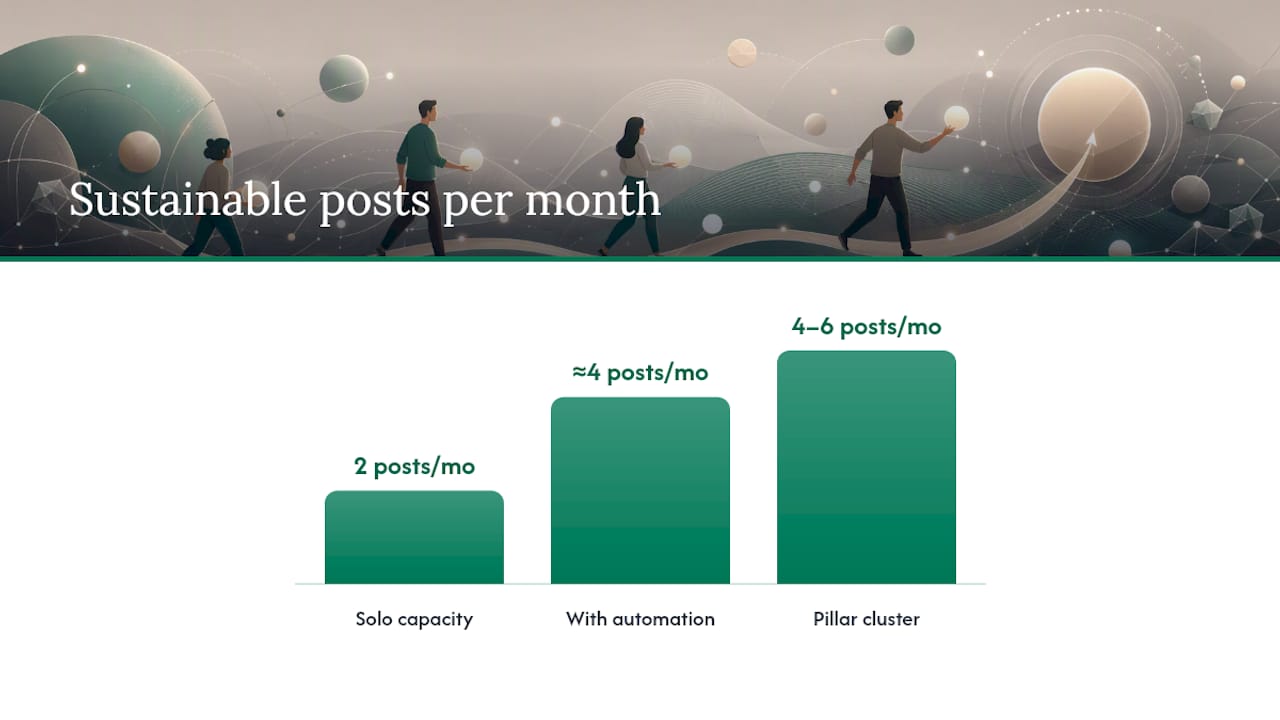
Start with a simple capacity formula: available content hours per week, divided by hours required per quality post, equals sustainable posts per month. A founder with 8 hours a week to spend on content, and roughly 4 hours needed to research, draft, and edit one solid post, lands at around 2 posts a month working solo. That’s the honest number before any automation enters the picture. Automation and repurposing can lift that closer to 4, but only if editorial review stays in the loop, because unsupervised volume is how quality erodes and citations disappear.
Once you know your real capacity, build a standard operating procedure so cadence survives beyond your own memory:
- Brief. Define the keyword, angle, and the one opinion or data point the piece must include.
- Draft. Whoever (or whatever tool) writes first pass has a 48-hour SLA.
- Review. A second set of eyes checks facts, sources, and voice, not just grammar.
- Design. Add custom graphics; Stratabeat’s data ties original graphics to a meaningfully bigger traffic uplift than stock imagery.
- Publish. On a fixed day, not “whenever it’s ready.”
- Promote. Slice into 3 to 5 channel-specific posts within 48 hours of publishing.
Assign an owner to each step, even if one person owns four of the six. Ambiguous ownership is where cadence quietly dies.
Pro Tip: Build your calendar around pillar clusters, not individual posts. One cornerstone page plus 3 to 5 supporting posts gives you a month of content that all links together, instead of six disconnected ideas competing for the same search intent.
Layer in seasonal ramps and launch offsets deliberately. If you’re shipping a major feature in six weeks, start publishing supporting content now so it’s already ranking when the announcement drops. That’s the SaaS-specific version of aligning content with sales rhythms: content isn’t just marketing, it’s a forcing function that amplifies whatever the product team ships.
How Do You Know If Your Cadence Is Working?
Track five numbers, and track them per post, not just in aggregate: impressions, clicks, traffic per post, leads per post, and ranking movement over time. A monthly total tells you almost nothing about which specific pieces are pulling weight and which are dead ones.
Run cadence experiments carefully rather than swinging wildly between extremes. Ramp frequency up in small increments, say from 4 posts a month to 6, and hold that pace for 3 to 6 months before judging results. Where you can, use a holdout: keep one topic cluster at the old cadence while you increase frequency on another, so you can isolate whether the lift came from volume or from something else entirely, like a seasonal demand spike.
Sites publishing 9 or more posts a month saw a 20.1% jump in monthly organic traffic, according to Stratabeat’s 2025 SaaS research, a strong enough signal that most small teams should treat 9 posts a month as a real target, not an aspirational one.
Refreshing old content deserves its own line item on the calendar, not a “someday” tag. Treat it as recurring, non-negotiable work. A post that ranked well a year ago and has quietly slid to page two isn’t a lost cause; it’s usually a faster win than writing something new from zero, because it already has backlinks and some existing authority.
Keep the 80/20 split (new content to refreshes) as your default, but flip it temporarily when your analytics dashboard shows a cluster of posts losing rank at once, that’s usually a signal something changed in search results, not that your writing got worse. When traffic velocity on new posts starts flattening while your refresh candidates pile up, that’s your cue to pivot resources from producing more to protecting what you’ve already built.
A Weekly Playbook Small SaaS Teams Can Actually Run
Here’s what a realistic week looks like for a founder or a two-to-four-person marketing team trying to hit 8 to 10 pieces a month without losing their evenings.
- Monday. Research and brief one cornerstone piece; pull data, competitor gaps, and your own product angle.
- Tuesday. Draft the cornerstone post; block 3 to 4 uninterrupted hours if you’re writing it yourself.
- Wednesday. Edit and fact-check; add sources and confirm every claim traces back to something real.
- Thursday. Slice the cornerstone into 4 to 6 short-form posts for LinkedIn and X, plus one email pull.
- Friday. Schedule the week’s promotion, post the LinkedIn piece for the coming Monday at 7 a.m., and queue the refresh candidate for next cycle.
Automation earns its place in steps one, two, and four, not step three. A tool can pull research, draft a first pass, and generate channel variants far faster than a person starting from a blank page. What it should never replace is the editorial pass that confirms the piece still sounds like you and that every claim is actually citable. Crontent’s approach leans on this exact split: automate the research and drafting labor, keep a human checkpoint on voice and sourcing before anything goes live.
Pro Tip: Keep a running “claims log” for every cornerstone post, a simple list of every stat or claim and where it came from. It takes ten minutes and saves you from the slow credibility leak that happens when a reader (or an AI crawler evaluating whether your page is worth citing) finds one unsupported number.
The output worth aiming for isn’t just more posts. It’s content that holds up when AI search tools evaluate what to cite, which increasingly rewards specificity and sourcing over sheer word count.
Three Cadence Mistakes I See Founders Make Over and Over
The biggest one is treating cadence as a marketing decision instead of an operations decision. Founders will happily commit to shipping code on a two-week sprint cycle, then treat content like it’s optional homework that gets skipped the moment anything urgent comes up. Content cadence needs the same calendar weight as a release cycle, or it never survives contact with a busy quarter.
The second mistake is chasing benchmark numbers built for teams ten times their size. A solo founder trying to hit 20 posts a month because that’s what some enterprise case study mentioned is going to burn out in six weeks and quit the whole effort. Better to commit to 4 solid posts a month for a year than 20 rushed ones for six weeks.
The third is skipping refreshes entirely. Founders love writing new things and hate revisiting old ones, but a two-year-old post sitting on page two of search results is often one afternoon of editing away from page one again. That’s cheaper than any new post you could write.
If there’s one rule worth committing to this week, it’s this: block a recurring calendar slot for content, treat it as unmovable as payroll, and protect one afternoon a month purely for refreshing an old post instead of starting a new one.
— Jose
Where Crontent Fits Into Your Cadence
Crontent exists for exactly the gap this article keeps circling back to: small teams know what cadence they need, but don’t have the hours to hit it without sacrificing quality or their own voice. Agent-based workflows can research, draft, and cite scheduled content, blog posts, LinkedIn posts, X posts, and short video scripts, helping a founder or a two-person marketing team maintain a publishing rhythm without constant calendar management.

What makes it different from generic AI drafting tools is that content can be sourced and shaped around actual opinions, not generic templates. It offers user control, does not auto-publish without review, and avoids forcing unsustainable volume commitments. If you’re a solo founder or a small SaaS team trying to hit that 4 to 8 post monthly range without hiring a full content function, visit Crontent and start your first content run with a free trial.
Where to Read More on Publishing Frequency and Timing
- Sprout Social’s best-times-to-post research for LinkedIn and cross-platform timing data
- The 12-study meta-analysis on blog frequency behind the 9 to 11+ posts a month benchmarks
- Content Marketing Institute’s guide to deciding publishing frequency across channels
- Stratabeat’s 2025 SaaS publishing data on traffic growth tied to frequency and content quality
- HarbourSide Digital’s services overview for teams considering outside help with volume
Sources
- Best times to post on LinkedIn | Sprout Social
- How often should a business blog? 12 studies analyzed
- How Often Should You Publish Blog Posts? The Data-Driven Answer for 2026
FAQ
What Is the Rule of 40 in SaaS?
The Rule of 40 says a healthy SaaS company’s growth rate plus profit margin should add up to 40% or higher. It’s a financial benchmark, not a content metric, but it matters here because it’s often the ceiling on how much a team can spend on content production.
What Is the 70/20/10 Rule for Content?
The 70/20/10 rule allocates 70% of content to proven, reliable formats your audience already responds to, 20% to variations on that proven work, and 10% to experimental formats or channels you haven’t tried yet. It’s a useful ratio for deciding where to spend limited hours once your core cadence is stable.
What Is the 3-3-3 Rule in Marketing?
Definitions vary depending on the source, but one common version suggests spending 3 minutes on the hook, 3 sentences on the core message, and 3 seconds to make the call to action obvious, mostly applied to short-form social copy rather than long-form blog content.
Is SaaS Being Replaced by AI?
No. AI tools are changing how SaaS companies build and market products, including how content gets researched and drafted, but SaaS as a delivery and pricing model remains intact. What’s shifting is which SaaS companies survive: the ones that use automation like Crontent to stay visible and credible tend to outpace those that treat AI as a shortcut around quality.
How Often Should a Small SaaS Team Publish Blog Content?
Most solo founders and 1 to 4 person teams can sustainably publish 4 to 9 posts a month, with Stratabeat’s data showing 9 or more posts a month driving a 20.1% increase in monthly organic traffic when quality holds steady.