Social Proof SaaS Strategies That Turn Visitors Into Buyers

Social proof in SaaS is any signal from real customers, users, or third parties that convinces a prospect your product works before they take the risk of trying it themselves. If you only do one thing this week, put a hero logo bar with three to six recognizable customers directly under your headline, paired with one quantified result (“cut onboarding time by 40%”) or a review rating pulled from a platform like G2.
That combination works because it hits both halves of buyer psychology at once: recognition (other companies like mine use this) and proof (it actually delivered a number). Salesforce frames social proof as one of the cheapest credibility levers available to small businesses, and for SaaS specifically, the stakes are higher than most categories because buyers can’t touch or see the product before committing budget.
Here’s what to prioritize first, in order:
- Hero logo bar — 3 to 6 recognizable customer logos, above the fold, no exceptions.
- One quantified case snippet — a single sentence with a real number, not a vague claim.
- A visible review rating — even a small badge from a review platform beats no third-party signal at all.
- A named testimonial with a title — “VP of Ops at [Company]” carries more weight than “Sarah K.”
Everything past this point is optimization. Get these four live, then move to the deeper formats below.
Key Takeaways
Social proof works in SaaS because it replaces a prospect’s uncertainty with someone else’s verified experience, and quantified, permission-based proof consistently outperforms vague or anonymous claims.
| Point | Details |
|---|---|
| Start with the hero | Add a logo bar plus one quantified case snippet above the fold before anything else. |
| Match proof to funnel stage | Use logos for awareness, testimonials for consideration, case studies for evaluation, realtime signals for decision. |
| Quantify everything | Replace vague praise with specific numbers tied to a business outcome, as B2B buyers weight this heavily. |
| Automate collection, not writing | Trigger outreach through CRM events like NPS scores or usage milestones, but keep approval manual. |
| Measure before scaling | Track conversion lift, trial-to-paid rate, and deal close rate before rolling proof changes site-wide. |
Table of Contents
- What Types of Social Proof Work Best for SaaS Companies?
- Where Should Social Proof Appear Across the SaaS Buyer Journey?
- Copy-Ready Templates for Testimonials and Case Studies
- How Do You Collect Social Proof Without a Dedicated Team?
- What Metrics Prove Social Proof Is Actually Working?
- What Mistakes Undermine Social Proof Credibility?
- How Crontent Helps Small SaaS Teams Operationalize Proof
- Turning Social Proof Into a Repeatable Growth Habit
- What Actually Matters in Social Proof Strategy
- Sources
What Types of Social Proof Work Best for SaaS Companies?
Not all proof carries equal weight, and stacking the wrong type in the wrong place wastes the trust you’re trying to build. Here’s the full toolkit, ranked roughly by effort versus payoff.
- Customer logos — fastest to implement, weakest on their own. Logos say “credible companies use this” but prove nothing about outcomes. Use them as a visual anchor, not a closing argument.
- Written testimonials — a short quote with a name, title, and company. Keep these under 40 words for hero placement; longer ones belong on dedicated testimonial pages.
- Third-party review stars — pulling a rating from G2 or a similar platform tells prospects you’ve survived scrutiny you didn’t control. That’s precisely why it works: buyers know a company can’t fake a public review score the way it might polish a homepage quote.
- Realtime notifications — the small popups showing “Alex from Chicago just signed up.” These signal current activity rather than historical results, and they need real volume behind them to avoid looking staged.
- User-generated content (UGC) — screenshots of customers praising your product on X, LinkedIn posts, or community forums. Embedding an actual social post (not a paraphrase) adds a layer of authenticity screenshots alone can’t fake.
- Video testimonials — a customer talking through their own words, unscripted, does something text can’t: it removes the reader’s need to imagine tone or sincerity. RemoteVideoTestimonials notes that video shortens sales cycles precisely because it delivers a specific, credible narrative faster than a written case study.
- Badges and certifications — SOC 2, GDPR compliance, industry awards. These matter more in security-sensitive categories (fintech, healthtech) than in lightweight productivity tools.
- Social counters — “12,000 teams onboarded” or “2 million reports generated.” These work best when the number is large enough to feel impressive but specific enough to feel real.
Pro Tip: Pair every quote-based testimonial with a job title and company size (“Head of Growth, 40-person startup”). Prospects unconsciously look for someone who resembles their own situation, and a title without context does half the work of one with it.
Creative variants worth testing: embed an actual LinkedIn post praising your product (screenshots feel dated, live embeds feel current), cut a 15-second video reel from a longer customer interview for social ads, and tie individual testimonials to the specific feature they praise rather than lumping them all on one generic page.
Where Should Social Proof Appear Across the SaaS Buyer Journey?
Proof that works at the top of the funnel often falls flat at the bottom, and vice versa. Buyers in the awareness stage don’t want a 12 page case study. Buyers about to enter a credit card want more than a logo.
- Awareness (hero, homepage, ads): Logo bars and aggregate numbers. “Trusted by 500+ marketing teams” works here because it’s scannable in two seconds.
- Consideration (feature pages, blog, comparison content): Feature-specific testimonials. A quote tied directly to the feature being described on that page carries more weight than a generic homepage testimonial repeated everywhere.
- Evaluation (pricing page, demo request, sales deck): Case studies with ROI data and third-party review scores. This is where buyers are actively comparing you against alternatives, and vague praise won’t survive that scrutiny. NotiProof’s funnel mapping places quantified case studies squarely at this stage for good reason.
- Decision (signup flow, checkout, trial activation): Realtime signals and popularity badges. “Most popular plan” next to a pricing tier, or a small “14 companies signed up today” note near the signup button, nudges the fence sitters.
Page-level rules follow the same logic. Your hero section gets logos and one number. Feature modules get testimonials that reference that specific feature by name. Pricing pages need case studies and a visible star rating close to the CTA button. Signup flows benefit from a single social counter or a short trust badge, nothing heavier. Sales decks should carry your strongest 2 to 3 case studies, each with the buyer’s industry represented if possible.
If you sell to multiple buyer personas, a lot of teams show every buyer the same proof, which is a mistake. A technical evaluator wants a case study proving integration ease. A finance stakeholder wants a case study proving cost savings. Where your CRM allows it, segment which testimonial or case study a visitor sees based on referral source or firmographic data.
Copy-Ready Templates for Testimonials and Case Studies
Staring at a blank page kills more social proof initiatives than any technical barrier. Here are structures you can fill in within minutes.
Hero quote template: “[Result in one sentence].” — [Name], [Title] at [Company]
Feature testimonial template: “[Feature name] solved [specific problem]. Before, we [old pain point]. Now, we [new outcome].”
Pricing page badge template: “[Star rating] on [Review Platform] from [number] reviews” — placed directly beside the CTA button, not buried in a footer.
Signup micro-case template: “[Company] went from [starting metric] to [ending metric] in [timeframe].”
For a full case study, the Problem, Solution, Results structure remains the clearest format for B2B readers:
- Context — company size, industry, and what they were using before.
- Baseline — the specific pain point or metric before adoption (be precise: “average response time of 4 hours,” not “slow support”).
- Timeline — how long implementation took and how long until results appeared.
- Result — the quantified outcome, ideally two or three numbers rather than one.
- Quote — a short, specific line from the customer that reinforces the numbers rather than repeating them.
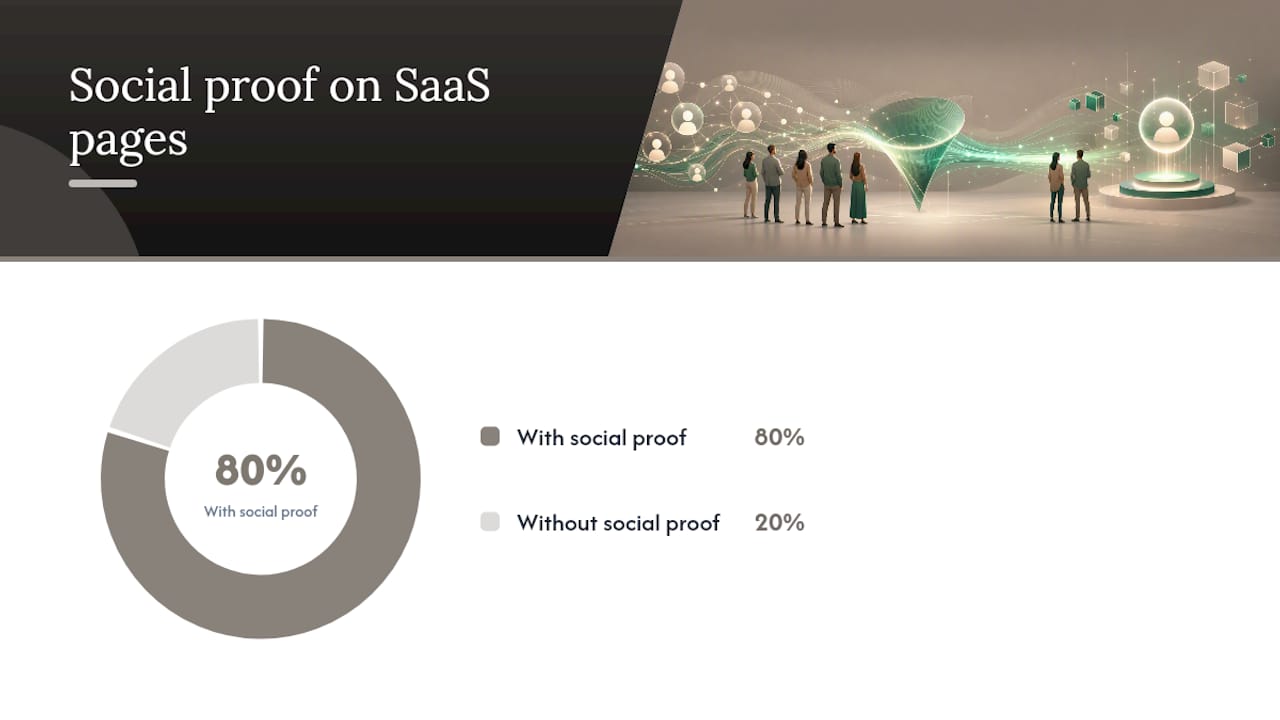
Annotated examples worth studying: LandingRabbit’s roundup shows that roughly 80% of SaaS landing pages carry some form of social proof, most commonly a logo bar directly under the hero and testimonials scattered across the homepage and feature pages. Look at how project management tools place a single bolded result (“47% faster project delivery”) above the fold, then let a longer written testimonial live further down the page for readers who scroll. Notice how pricing pages for well-known SaaS products often place a review star rating within eyeshot of the CTA, not tucked into a sidebar. And pay attention to how the best signup flows use a single line of proof, never more, because a cluttered signup screen kills conversions faster than a missing testimonial ever will.
How Do You Collect Social Proof Without a Dedicated Team?
Most small SaaS teams don’t lack good customers willing to vouch for them. They lack a repeatable process for asking at the right moment.
- Identify candidates. Pull your NPS promoters (9s and 10s), your longest-tenured accounts, and anyone who’s expanded their plan. These three groups are statistically the most likely to say yes.
- Send outreach at the right trigger point. The best moments are right after a support ticket gets resolved well, right after a customer hits a usage milestone, or immediately following a high NPS score. Waiting weeks kills the emotional momentum.
- Use a short, specific ask. Don’t ask “Would you be willing to share feedback?” Ask “Can we quote your comment about the 3 hours a week you’re saving?” Specificity gets far higher response rates than an open-ended request.
- Route through an approval flow. Every quote or case study needs sign-off from the customer before publishing, in writing, even if it’s just a one-line email reply.
- Automate the asking, not the writing. Salesforce recommends integrating review prompts into your CRM so they trigger automatically post-success, rather than relying on someone remembering to ask manually.
Automation patterns worth building: an in-app prompt that fires after a user completes a key action for the third time, an email sequence tied to your NPS survey that routes high scorers to a review platform link, and a syndication step where one testimonial gets reused (with permission) across your website, sales deck, and social channels instead of being requested three separate times.
Privacy and consent aren’t optional extras here. Always get explicit written permission before publishing a name, title, or company. If a customer wants to stay anonymous but their result is too good to leave out, anonymize the identifying details (“a 200-person logistics company”) while keeping the numbers intact. Where your business operates across multiple regions, check local data and consent requirements before publishing any customer’s information publicly.
Pro Tip: Keep a single spreadsheet or CRM view listing every testimonial you’ve collected, its approval status, and where it’s currently published. Teams lose track of which quotes are live, which are outdated, and which customers have since churned, and a churned customer’s glowing testimonial sitting on your pricing page is a credibility risk waiting to be noticed.
What Metrics Prove Social Proof Is Actually Working?
Adding testimonials because “it feels right” isn’t a strategy. Track these numbers to know whether your proof is pulling its weight:
- Conversion lift on pages where you add or change social proof, measured against a control period or an A/B split.
- Trial-to-paid rate, particularly after adding case study links or review scores to your pricing or checkout page.
- MQL to SQL velocity, since strong case studies often shorten the time a lead spends in evaluation before booking a sales call.
- Deal close rate, especially for sales teams using case studies directly in decks or follow-up emails.
- Pipeline velocity, tracking whether deals move faster through stages once reps start referencing specific customer results.
Run these as actual experiments, not gut-feel changes. Split test your hero section with and without a quantified case snippet. Test the cadence of realtime notifications (every visitor sees one versus only returning visitors) since overexposure can backfire. Run a cohort comparison on signups before and after adding a review badge near your CTA.
The scale of the opportunity is worth restating: since roughly 80% of SaaS landing pages already carry some social proof, the competitive question isn’t whether to add it but whether yours is more specific and better placed than what your competitors are running. Report results to stakeholders on a monthly cadence at minimum, tying each proof change to the metric it was meant to move rather than a general “engagement is up” summary.
What Mistakes Undermine Social Proof Credibility?
The line between persuasive and suspicious is thinner than most marketers assume, and crossing it damages trust faster than having no proof at all.
- Do quantify every claim where possible. “Saved time” means nothing; “saved 6 hours a week” means something.
- Do get written permission before naming a customer, and rotate which proof appears based on the page’s role in the funnel.
- Do link directly to your public review profile on a platform like G2 rather than only showing curated quotes you control.
- Don’t fabricate or round metrics upward. A customer who saved “about 20%” doesn’t become “over 25%” in your copy.
- Don’t overload pages with popups and counters until the page feels more like a casino floor than a product site.
- Don’t misattribute a result achieved partly through your customer’s own effort entirely to your product.
If a testimonial gets withdrawn or a customer asks you to remove their name, act within days, not weeks. If your average review rating drops after a rough quarter, don’t hide it. Address it directly in outreach to unhappy customers and let genuine improvement rebuild the score over time rather than trying to bury the dip with newer, cherry-picked reviews.
How Crontent Helps Small SaaS Teams Operationalize Proof
Collecting social proof consistently is a scheduling problem as much as a marketing one, and that’s exactly the gap Crontent’s publishing cadence is built to close for solo founders and small teams without a dedicated content function.

A workable rhythm looks like this: one capture step per week (a quick outreach email to a recent NPS promoter or milestone customer), one refreshed case study per month, and syndication across three touchpoints, your hero section, a feature page, and your pricing page, so a single strong result doesn’t sit unused in one spot.
Quick checklist for small teams:
- One proof capture action every week, even a five-minute email.
- One new or refreshed case study monthly, following the Problem, Solution, Results structure.
- Surface your best proof in three places minimum: hero, relevant feature module, and pricing page.
- Review your third-party rating quarterly and respond to any negative reviews within days.
…
Turning Social Proof Into a Repeatable Growth Habit
The teams that get social proof right treat it as an ongoing input to their content calendar, not a one-time homepage project, and that’s where a platform like Crontent fits into the workflow. Instead of remembering to chase a testimonial or refresh a stale case study, small SaaS teams can fold proof collection into the same scheduled cadence they already use for blog posts and social content, keeping the hero logo bar, feature testimonials, and pricing page case studies current without adding another task to someone’s Friday afternoon. If you’re not sure what content to prioritize first as a small team, proof assets are consistently the highest-leverage place to start because they compound: one good case study gets reused across five different pages and channels.
What Actually Matters in Social Proof Strategy
Most social proof advice treats every format as equally important, which leads teams to scatter effort across logos, badges, and counters while neglecting the one format that actually moves B2B deals: the quantified case study. The research is fairly blunt about this. Peer reviews and testimonials top the trust rankings for B2B buyers, but the versions that convert are the ones with a real number attached, not a warm quote about how “great the team is to work with.”
Where conventional advice falls short is treating social proof as a one-time website project rather than an operational habit. A hero logo bar you built two years ago with customers who’ve since churned is worse than no logo bar at all, because sharp buyers check. If you’re a small team reading this, prioritize the weekly capture habit over the perfect case study template. A rough but current testimonial beats a polished but stale one every time.
— Jose
Sources
- What is Social Proof? Everything You Need to Know
- Testimonials on SaaS Websites: 6 Fantastic Examples and Tips
- How SaaS Companies Use Video Testimonials to Shorten Sales Cycles and Win More Deals - Remote Video Testimonials
- G2