Small SaaS: Publish Thought Leadership and SEO Without a Content Hire

Thought leadership and SEO are not rivals fighting for your content calendar. SEO makes your content findable; thought leadership makes it worth finding. The winning approach for most small SaaS teams is a hybrid one: answer the searcher’s question first, using standard SEO and content marketing structure, then layer in an original data point or an executive’s real point of view. Lean on SEO for acquisition volume, and save deliberate thought-leadership pieces for the moments you need to shift how the market sees your category.
TL;DR:
- Small SaaS teams should combine SEO and thought leadership by first optimizing for search discoverability and then layering in original insights to influence the market.
- Thought leadership focuses on reputation and influence through evidence-backed, opinionated content, while SEO targets immediate search queries and traffic growth.
- Building hybrid content involves answering the query upfront, adding exclusive data or frameworks, and ending with actionable insights, not basic summaries.
- Metrics for success differ: SEO relies on rankings and traffic, while thought leadership depends on backlinks, citations, and inbound inquiries.
- Using sourced, research-backed drafts from tools like Crontent helps small teams efficiently produce both SEO and thought leadership content without additional headcount.
Table of Contents
- Thought Leadership vs. SEO: The Core Definitions
- SEO vs. Thought Leadership: Comparing the Job to Be Done
- When to Prioritize SEO Content vs. Thought Leadership
- A Practical Framework for Building Hybrid Content
- Measuring Results: SEO KPIs vs. Thought Leadership KPIs
- How Crontent Helps Small Teams Run Both Strategies
- A Short History of Thought Leadership and SEO
- Common Misconceptions About Thought Leadership vs. SEO
- Case Studies: What Happens When Teams Pick One Strategy Over the Other
- Pitfalls When Integrating Thought Leadership With SEO Content
- Audience Targeting: Search Intent vs. Buying Committees
- My Take: Stop Planning, Start Testing
- Publish Both Without Hiring a Content Team
- Sources
- FAQ
Thought Leadership vs. SEO: The Core Definitions
Confusing these two terms is the single biggest reason marketing teams waste effort producing content that neither ranks nor persuades anyone. Get the definitions straight and everything else in this article gets easier to apply.
Thought leadership is an original, defensible point of view backed by evidence, aimed at changing how a specific audience thinks about a problem. It doesn’t answer a search query so much as it reframes one. A CEO arguing that “usage-based pricing kills retention for mid-market SaaS” is thought leadership. It’s a claim someone could disagree with, which is the point.
SEO content, by contrast, is query-first and intent-matching. It exists to satisfy an immediate need someone typed into a search bar. “How to calculate churn rate” is SEO content. Nobody expects a controversial opinion. They want the formula, fast.
The format differences follow naturally from those goals:
- Thought leadership formats: proprietary research reports, contrarian essays, executive webinars, panel discussions, opinionated LinkedIn posts, framework launches.
- SEO content formats: how-to guides, glossary and explainer pages, comparison posts, feature breakdowns, FAQ-driven pages.
Google’s own SEO starter guide still treats crawlability, unique content, and clear headings as the baseline for visibility, whether or not the content also carries a strong opinion. That’s the reconciling fact most teams miss: nothing about having a point of view exempts you from writing content Google can actually parse and rank.
The overlap is where things get interesting. A comparison post can carry a viewpoint (“most vendor comparisons like this one ignore data residency, and that’s a mistake”). A research report can be structured so the first paragraph answers a specific search query before it gets into the proprietary findings. Treating the two as mutually exclusive is what causes most of the wasted content budget at small SaaS companies. They’re not different species of writing. They’re different priorities layered onto the same page.
SEO vs. Thought Leadership: Comparing the Job to Be Done
Once you separate the two by objective, the practical trade-offs become obvious, and so does the resourcing mistake most small teams make: treating both as if they run on the same production line.
SEO content chases discoverability. It succeeds when a stranger with a problem finds your page in the first page of results and gets an answer fast enough to trust you with the next question. Thought leadership chases influence and consideration. It succeeds when someone already evaluating vendors remembers your framework in a meeting, or when a procurement lead cites your report in an internal memo nobody outside the buying committee will ever see.
That split shows up in every operational dimension:
- Audience behavior: SEO content meets people mid-search, often with low brand awareness. Thought leadership reaches people already inside a buying journey, usually through newsletters, LinkedIn, or a conference talk, not a Google query.
- Production cadence: SEO content is fast and repeatable, built around keyword clusters and templates. Thought leadership is slower and research-heavy, gated by whoever owns the original insight (usually a founder or senior SME).
- Resource demands: SEO content needs an editor and a keyword list. Thought leadership needs primary research, a credible voice, and time for that voice to actually think, which is the resource small teams underfund most often.
- Success signals: SEO succeeds on rank position, organic sessions, and click-through rate. Thought leadership succeeds on backlinks, executive mentions, and inbound requests from people who already trust you before they contact you.
That last point explains a measurement blind spot a lot of marketing teams walk straight into. Last-click attribution treats a $50,000 deal as “direct traffic” when the actual driver was a report someone read three months earlier and never clicked through from. Edelman’s B2B thought leadership research calls these readers “hidden buyers,” and they’re the reason thought leadership keeps getting undervalued by dashboards that only count last-touch conversions.
When to Prioritize SEO Content vs. Thought Leadership
Your business goal should decide the format, not your content calendar’s open slots. Here’s a working decision framework you can apply to any topic on your list.
- If the goal is pure acquisition volume, default to SEO. Keyword-driven how-to and comparison content compounds over time and needs the least executive bandwidth to produce consistently.
- If the goal is category creation or pricing power, default to thought leadership. You cannot SEO your way into being seen as the category’s authority. That requires an original claim someone has to react to.
- If the goal is mixed (you need both traffic and credibility on the same topic), build a hybrid piece. Answer the query first, then spend the second half making an argument nobody else in the search results is making.
- Check team readiness before committing to thought leadership. Someone has to own the research, someone has to own the opinion, and an executive has to actually be available for interviews or drafts. If none of that exists yet, don’t fake it.
- Watch for two traps that waste effort on both sides. The first is dressing up thin, unsupported opinion as thought leadership because it’s faster to write than doing real research. The second is stuffing a “thought leadership” post with keywords until the actual point of view gets buried under headers optimized for search volume instead of clarity.
The traps matter more than they sound like they should. A thin opinion piece with no evidence gets ignored by the exact audience thought leadership is supposed to win over, senior buyers who’ve read a hundred generic takes already. And a keyword-stuffed opinion post ranks for nothing memorable while reading like it was written by committee. Neither failure is about lacking talent. Both come from skipping the planning step of deciding, honestly, which job the piece is actually doing.
A Practical Framework for Building Hybrid Content
Here’s the part most guides skip: an actual repeatable structure you can run without a research department. It’s a three-step template, and it works because it forces sequencing instead of asking writers to somehow balance two goals at once in every sentence.
Step one: answer the query up front. Open with the direct answer to whatever the reader searched for, structured the way SEO best practice recommends, clear headers, a fast answer in the first few sentences, no throat-clearing. This isn’t a concession to search engines. Backlinko’s synthesis of SEO best practices points out that structured, answer-first sections are also what make content more likely to get cited by AI systems, so the “boring” SEO discipline pays off twice.
Step two: add something nobody else has. This is where the piece earns the “thought leadership” label. It might be a data point from your own product usage, a framework you built internally, or a genuinely contrarian read on the conventional advice. Industry analysis of hybrid content confirms this pattern works because answer-first structure paired with exclusive evidence tends to both rank and get linked, rather than forcing a choice between the two outcomes.
Step three: close on implications, not a recap. Tell the reader what your point of view means for their next decision, and invite deeper engagement, a follow-up piece, a tool, a conversation.
Tactically, this shows up in a few specific signals:
- The headline states a finding or a stance, not just a topic (“Why usage-based pricing backfires below $2M ARR” beats “A Guide to SaaS Pricing Models”).
- The standfirst or intro line carries the actual opinion, not a summary sentence that could apply to any competitor’s post on the same keyword.
- Metadata and title tags still target the query, because a strong opinion buried under bad on-page SEO reaches nobody outside people who already follow you.
On a small team, four roles cover this without needing four separate hires: a researcher who gathers evidence, a POV owner (usually the founder or a senior SME) who supplies the actual stance, an SEO editor who keeps structure and metadata honest, and a promotion lead who gets the piece in front of the right buying-committee members after publication.
Pro Tip: Pair every “how to” post with a one-line internal note asking, “What do we believe about this that our competitors would disagree with?” If you can’t answer it, publish it as pure SEO content and don’t force a POV that isn’t there yet.
Not every piece needs both layers. A straightforward how-to page paired with a brand-new framework can become a hybrid post. A trend explainer paired with a proprietary chart from your own product data can too. But a basic glossary definition doesn’t need a hot take bolted onto it, and forcing one just adds friction for the reader.
Measuring Results: SEO KPIs vs. Thought Leadership KPIs
You can’t apply the same scorecard to both formats and expect either number to mean anything.
SEO KPIs are direct and immediate:
- Keyword rank position for target queries
- Organic sessions and traffic trend over time
- Click-through rate from search results
- Conversion rate from organic visitors to trial or demo signups
Thought leadership KPIs are slower and more indirect:
- Backlinks earned without outreach
- Inbound inquiries that reference the piece by name
- Time on page and scroll depth as engagement proxies
- Share volume and citation by other publications or analysts
Edelman’s research with LinkedIn found that high-quality thought leadership measurably affects vendor consideration and RFP participation among senior buyers, impact that a last-click SEO dashboard will never surface because the reader never clicked a conversion path in the first place.
The practical fix is attribution discipline, not better software. Use assisted-conversion windows that look 60 to 90 days back instead of last touch only. Run cohort analysis on deals that closed and ask sales what content came up in conversation. Track brand mention volume separately from traffic, since a spike in unbranded search for your framework’s name is a thought-leadership signal SEO tools won’t label as one. And don’t overreact to a single month’s numbers. Thought leadership KPIs especially need a few quarters of data before a trend means anything.
How Crontent Helps Small Teams Run Both Strategies
Reconciling these two approaches sounds reasonable in a strategy deck and falls apart the moment a two-person marketing team has to actually produce both formats every week. That’s the real gap Crontent is built to close.
Crontent’s agent-based workflow drafts research-backed posts before any human editing happens, pulling from current, full-length sources and citing them, rather than starting from a blank page or a thin AI summary. That preserves the “exclusive evidence” layer the hybrid framework calls for, because every draft is grounded in sourced material instead of generic filler. For prioritizing SEO fundamentals against newer AI-driven discovery tactics, that sourcing discipline matters more than ever.
A small team can sustain a weekly blog post, a few LinkedIn drafts, and periodic thought-lead pieces without a dedicated content hire, because the platform handles discovery and drafting while a founder still supplies the actual opinion and reviews before anything publishes.
A Short History of Thought Leadership and SEO
These two disciplines grew up almost entirely separately, and that separation explains why marketing teams still treat them as competing budgets today.
Thought leadership predates the internet by decades. Management consultants and business school professors built the term on the back of white papers and keynote speeches long before anyone typed a query into a search box. The goal was always the same: get decision makers to associate a name with an idea.
SEO, by contrast, is a search-engine artifact, born in the late 1990s once webmasters realized ranking position drove traffic and traffic drove revenue. Early SEO had almost nothing to do with authority or ideas. It was about keyword density and backlink counts, mechanics divorced from any real point of view.
The two worlds started colliding once content marketing scaled in the 2010s and companies realized blogs could do double duty: capture search traffic and build a brand’s reputation at the same time. Google’s own ranking systems accelerated that collision by penalizing thin, keyword-stuffed pages and rewarding genuinely useful, original writing, which is exactly the terrain thought leadership already occupied.
That convergence is now formalized. Google’s guidance on AI-era search confirms that generative features are grounded in the same core ranking systems as classic search, and that unique, helpful content still matters just as much for those new surfaces. The two disciplines aren’t separate lanes anymore. They’re one lane with two different gears.
Common Misconceptions About Thought Leadership vs. SEO
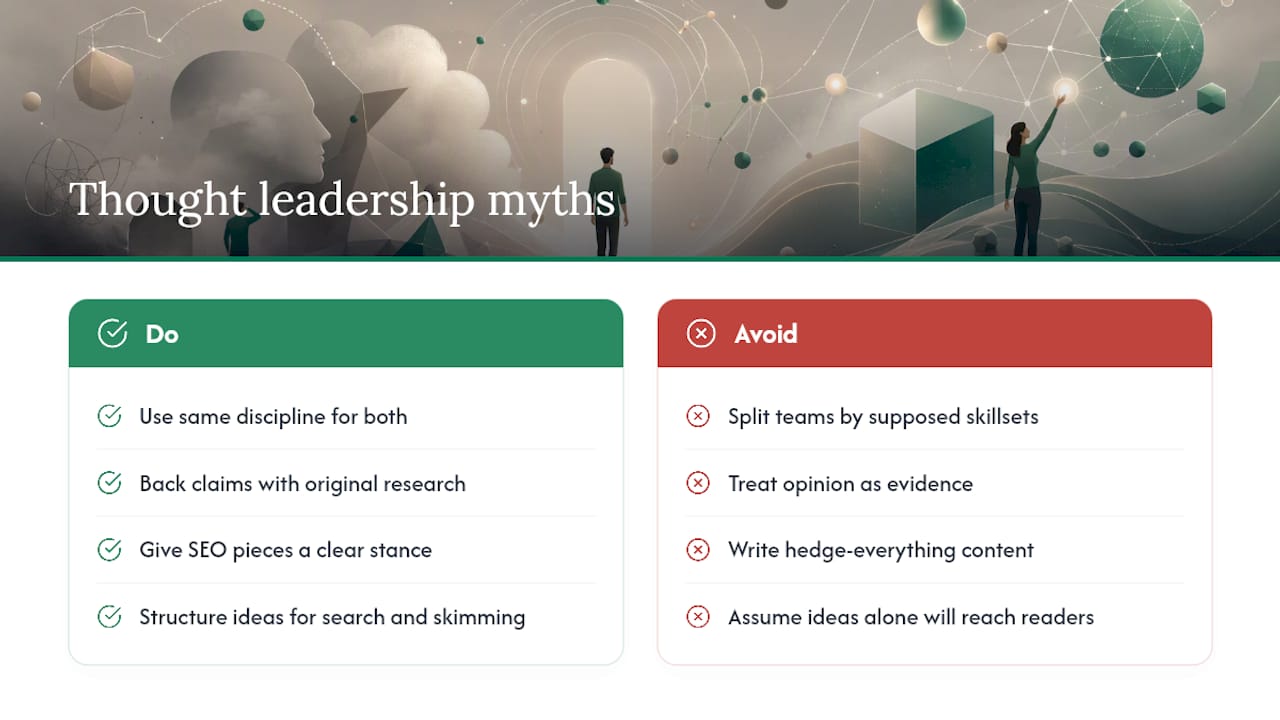
The biggest misconception is that thought leadership and SEO content require opposite skill sets, and therefore opposite teams. In practice, the underlying discipline, clear writing, real evidence, honest structure, is identical. What differs is the starting question: “What is this person searching for?” versus “What do we believe that others don’t?”
A second misconception treats opinion and evidence as interchangeable. A hot take without data is not thought leadership; it’s just an opinion piece with better branding. FT Longitude’s research on thought leadership strategy is blunt about this: original research and strong storytelling are what separate credible thought leadership from filler, and skipping either one is the most common reason these programs fail.
A third misconception assumes SEO content can’t carry a point of view, so teams write it flat and generic on purpose. That’s backwards. A comparison post with a clear stance on which approach is actually better for a specific use case will usually outperform a neutral, hedge-everything version, both in engagement and in how confidently readers act on it.
The fourth, and maybe the most damaging inside small teams, is assuming thought leadership doesn’t need SEO discipline because “the ideas speak for themselves.” They don’t, not to a search engine, and often not even to a human skimming on mobile. A brilliant framework buried under a wall of unstructured text will get read by almost nobody outside the people who already follow the author on LinkedIn.
Case Studies: What Happens When Teams Pick One Strategy Over the Other
The clearest failure pattern shows up in companies that go all-in on SEO volume and treat every post as interchangeable keyword bait. Traffic climbs for a while, then plateaus once competitors copy the same structure for the same queries, and nothing about the brand sticks in a buyer’s memory. The content ranks. Nobody remembers who wrote it.
The opposite failure is just as common, and arguably more expensive. A founder publishes ambitious essays and research reports with real substance, but skips basic SEO structure entirely, no clear headers, no query targeting, buried behind paywalled newsletters instead of indexable pages. The ideas are good. Almost nobody outside existing subscribers ever finds them, and the domain earns none of the compounding search value that good writing should generate over time.
The success pattern sits in the middle, and it’s less dramatic than either failure. Teams that pair a steady SEO content cadence with occasional, well-researched thought-leadership pieces build both traffic and reputation over 12 to 18 months. The SEO content keeps the top of the funnel full. The thought leadership pieces get cited, linked, and remembered by the exact senior buyers who eventually decide the deal. Neither format alone produces that compounding effect. Search Engine Land’s guidance on thought leadership frames this correctly: earned backlinks and brand mentions from strong thought leadership indirectly lift the SEO performance of everything else on the domain.
Pitfalls When Integrating Thought Leadership With SEO Content
The most common failure is sequencing the two backwards. Writers draft the opinionated section first, then bolt on keyword-targeted headers afterward as an SEO afterthought. The result reads like two different documents stapled together, and readers notice the seam immediately.
A second pitfall is letting SEO metadata flatten the actual point of view. Title tags and meta descriptions written purely for search volume often strip out the specific claim that made the piece worth reading, leaving a generic headline over genuinely original content.
A third pitfall is understaffing the research step. Thought leadership requires primary evidence, proprietary data, direct interviews, a genuinely new framework, and small teams under deadline pressure often substitute secondary summarization instead. That produces content that looks like thought leadership in format but reads like a competent SEO post wearing a blazer.
A fourth, quieter pitfall is measurement mismatch: judging a hybrid piece purely on organic sessions in its first 30 days, then killing the format because the thought-leadership half hasn’t had time to earn backlinks or executive attention yet. Give hybrid pieces the longer measurement window thought leadership actually needs, not the 30-day sprint SEO content gets judged on.
Audience Targeting: Search Intent vs. Buying Committees
SEO content targets a query, which means it targets whoever is typing that query, regardless of seniority or buying authority. A junior marketer researching churn formulas and a VP evaluating vendors might both land on the same how-to page. That’s fine. The content’s job is to answer the question well enough to earn trust, not to filter for title.
Thought leadership targets a role, not a query. It’s written with a specific buying-committee member in mind, a CFO skeptical of a pricing model, a technical lead worried about integration risk, and it succeeds by giving that person language and evidence they can use internally to advocate for a decision. That’s a narrower target by design.
The practical implication is that your distribution channels should match the targeting logic. SEO content lives or dies by organic search, so on-page structure and query matching carry most of the weight. Thought leadership needs deliberate distribution, LinkedIn, email newsletters to a segmented list, direct outreach to analysts, because the right reader often isn’t searching for anything. They’re just the person your research needs to reach.
My Take: Stop Planning, Start Testing
Most of the debate around thought leadership vs. SEO is really a stalling tactic. Teams spend months building frameworks and decision trees instead of publishing one hybrid piece and watching what actually happens to it. Planning feels like progress. It rarely is.
Here’s a workable checklist. In the first 30 days, pick one recurring SEO topic and rebuild it with a genuine internal opinion attached, then publish it and track backlinks alongside rank position. In the next 90 days, interview your own product usage data or your founder for one proprietary claim worth building a full report around. By 180 days, you should have enough cohort data to know whether your hidden-buyer inquiries are actually moving, not just your organic sessions.
Evidence beats elegance here. A rough hybrid post published this week teaches you more than a perfect framework sitting in a shared doc. If you want a structural head start on the SEO half of that equation, Crontent’s guide to getting cited in AI search results is worth a read before your next draft.
— Jose
Publish Both Without Hiring a Content Team
Crontent gives small SaaS teams the one thing this hybrid approach actually demands: research-backed drafts that already carry sourced evidence, not another generic AI summary you have to fact-check line by line. Every draft cites its sources, keeps your own voice, and waits for your review before anything goes live, so the founder’s actual point of view still makes it into the final post instead of getting flattened by automation.

For a two-person marketing team, that means a sustainable weekly SEO post plus room for the occasional thought-leadership piece, without adding a headcount line to the budget. The plans cover different publishing cadences, and current pricing for each is available on the Crontent site. New accounts get a free trial on their first content run, so you can see a research-backed draft land in your inbox before committing to anything. If your backlog is full of “how to” posts with no opinion attached, that’s the fastest place to start testing the framework this article laid out.
Sources
- AI optimization guide | Google Search Central
- 2025 B2B Thought Leadership Impact Report | Edelman
- Thought Leadership Content: Build Authority & Trust | Search Engine Land
- Thought leadership strategy: A step-by-step guide | FT Longitude
FAQ
What Are the Four Types of SEO?
The four commonly recognized types are on-page SEO (content and HTML elements), off-page SEO (backlinks and brand mentions), technical SEO (crawlability, site speed, structured data), and local SEO (location-based ranking factors). All four still matter for AI-driven search features, since Google’s own guidance confirms generative results are grounded in the same core ranking systems as classic search.
Is Elon Musk a Thought Leader?
Musk is widely cited as an example of high-visibility executive commentary shaping public perception of an industry, which is one function thought leadership serves. Whether that visibility counts as thought leadership in the disciplined sense, backed by original research and evidence, depends on the specific claim being made, not just audience size.
Are LinkedIn Thought Leader Ads Worth It?
LinkedIn’s thought leader ad format can extend the reach of a genuinely strong post, but it amplifies whatever is already there. Edelman’s research found that thought leadership already influences buying-group behavior organically, so paid amplification tends to work best on posts that already carry real evidence, not generic commentary dressed up as insight.
Is SEO Being Replaced by AI?
SEO is not being replaced by AI search features. It is changing shape. Google’s guidance states plainly that helpful, unique, people-first content remains the baseline for both classic search results and newer AI experiences, with no special markup required to appear in them.
Can Crontent Handle Both SEO Content and Thought Leadership Drafts?
Crontent’s workflow drafts research-backed content for both formats, structuring posts to answer search queries first while pulling in cited evidence a founder can shape into an actual point of view. Pricing for available plans is listed on the Crontent site, with a free trial available for a first content run.